A DDoS protected server in France gives you two things at once: a machine in a French data centre, under French and EU law, and a filter in the provider's network that drops attack traffic before it reaches that machine's port. We sell both in Paris and Marseille, with identical protection tiers in each. Below: what France's cyber agency has recorded, what its response team says to do first, where NIS2 stands, and which city suits which users.
What ANSSI recorded in 2024 and 2025
ANSSI, France's national cybersecurity agency, publishes a yearly Panorama de la cybermenace. The 2024 edition shows DDoS attacks against French targets roughly doubling on 2023, with extra activity around the Paris Olympics and Paralympics. The 2025 edition, published on 11 March 2026, records a notable decline from that peak, yet DDoS was still the most common action ANSSI saw used to destabilise French organisations.
What changed matters more than the count. In 2025, ANSSI writes, targets faced attacks of growing scale packed into short windows, which made them hard to qualify and contain while they were happening. DDoS is also increasingly used by cybercriminals, not only hacktivists, including as extra pressure on extortion victims. Short, intense attacks punish any defence that needs a human to switch it on.
March 2024: a flood on the state's own network
The best-known French case began on Sunday 10 March 2024. Between that evening and the Tuesday, several state services came under attacks that the government's spokesperson told the Senate used classic techniques at an "unprecedented intensity", and a crisis cell was activated to deploy countermeasures. ANSSI's account names the target: the Réseau interministériel de l'État (RIE), the network linking the ministries, hit for several days with significant impact on several ministries despite blocking measures applied quickly.
That network had a national agency behind it, and fast blocking still left ministries disrupted. A business with one server has far less, which argues for a filter in place before an attack, not arranged during one.
What CERT-FR says to do first
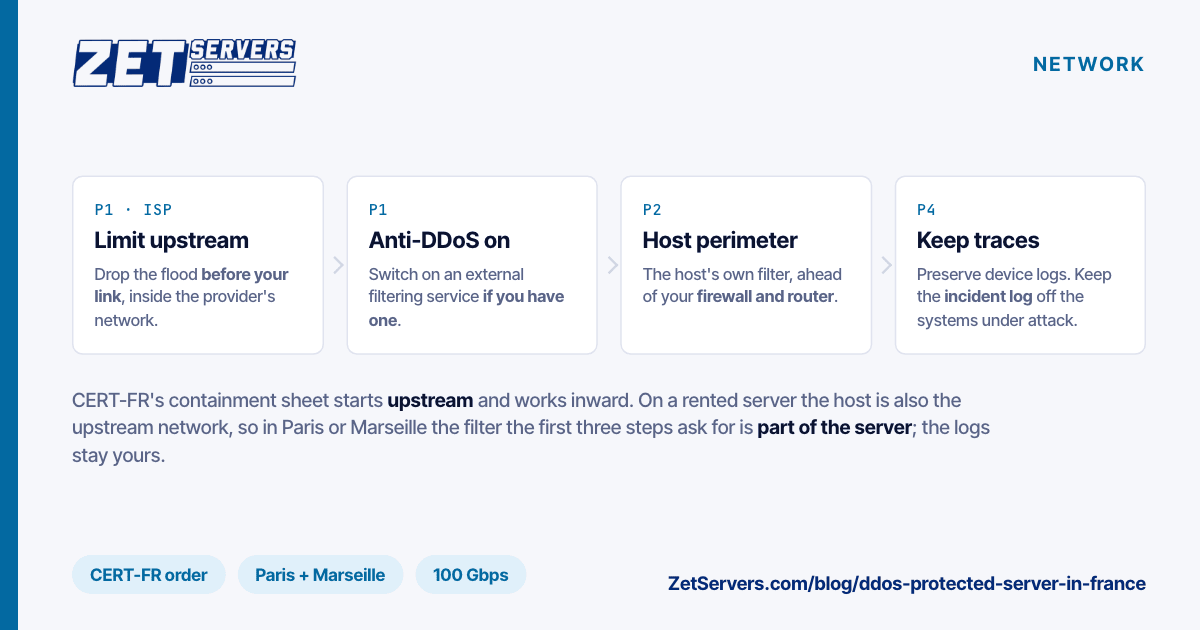
CERT-FR, the response team inside ANSSI, publishes reflex sheets for qualifying and containing a network denial of service, last revised in July 2025. The containment sheet ranks its actions, and the first-priority steps start upstream: limit traffic with the internet provider before it reaches you, and switch on an external anti-DDoS service if one exists. Work inside the host's perimeter, including the host's own filter ahead of your firewall and router, comes next; preserving traces comes last. It also advises asking the provider in advance about service levels, costs and how long filtering takes to start.
For a rented server the host and the upstream network are the same, so a DDoS protected server in France settles those first steps in the contract: filtering capacity sits in our network, ahead of your port, from the included 100 Gbps tier upwards. The rest of the sheet stays yours. Keep a running incident log, one line per action with time and name, stored away from the systems under attack, and know which component of your service fails first.
Where NIS2 stands in France
NIS2 was due to be transposed by 17 October 2024. France's vehicle is the projet de loi relatif à la résilience des infrastructures critiques et au renforcement de la cybersécurité, which carries three EU directives, NIS2 among them. The Senate adopted it on 12 March 2025, the Assemblée nationale's special committee adopted its version on 10 September 2025, and the Assemblée's legislative file shows the floor debate opening on 9 November 2026. Until both chambers agree a text and it is promulgated, it is not law.
The government's impact study expects regulated entities to rise from about 500 to about 15,000, and sectors from 6 to 18. The text makes regions, départements and communes over 30,000 inhabitants essential entities.
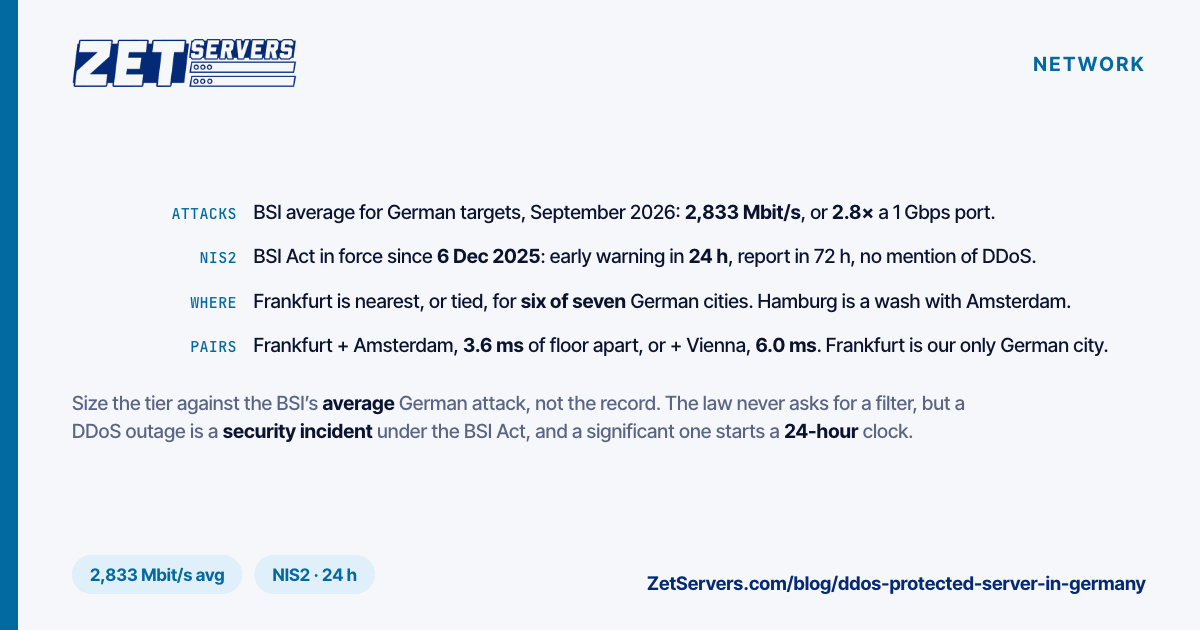
In the committee text, Article 14 requires proportionate risk-management measures with four aims, the fourth being to guarantee the resilience of activities, networks and information systems. Article 17 sets the reporting clock for a significant incident: initial notification to ANSSI within 24 hours, an intermediate one within 72 hours, a final report a month later. The text never names DDoS protection. A filter can serve the resilience aim; whether it is enough is for your own risk analysis. This is not legal advice.
Paris or Marseille for a DDoS protected server in France
With identical protection, latency decides. The floor is great-circle distance ÷ 100. For a working estimate, multiply the better city's floor by 1.3–1.5, plus 1–2 ms of router delay, then confirm the real path with mtr before ordering.
| Users in |
Paris floor |
Marseille floor |
Better French city, estimate |
Closer outside France |
| Lille |
2.0 ms |
8.3 ms |
Paris, 4–5 ms |
— |
| Nantes |
3.4 ms |
7.0 ms |
Paris, 5–7 ms |
— |
| Strasbourg |
4.0 ms |
6.1 ms |
Paris, 6–8 ms |
Frankfurt, 1.8 ms |
| Bordeaux |
5.0 ms |
5.1 ms |
Either, 8–10 ms |
— |
| Lyon |
3.9 ms |
2.8 ms |
Marseille, 5–6 ms |
— |
| Toulouse |
5.9 ms |
3.2 ms |
Marseille, 5–7 ms |
— |
| Nice |
6.9 ms |
1.6 ms |
Marseille, 3–4 ms |
— |
| Algiers |
13.5 ms |
7.5 ms |
Marseille, 11–13 ms |
Madrid, 7.1 ms |
| Tunis |
14.8 ms |
8.3 ms |
Marseille, 12–14 ms |
— |
Paris covers the north and the west; Marseille the Rhône valley, the Mediterranean coast and the Maghreb. Two rows point abroad, and we would rather say so: Strasbourg is closer to Frankfurt, and Algiers is a fraction closer to Madrid.
KVM VPS is sold in Paris but not in Marseille. A southern audience on a VPS budget accepts the extra milliseconds from Paris or moves up to a dedicated server in Marseille; the Marseille guide covers that city in depth.
Two cities, one country, the same filter
Paris and Marseille are 661 km apart, a 6.6 ms floor. Running a DDoS protected server in France in each city gives the service a second failure domain without moving data abroad: a facility outage, an upstream fault or an attack that outgrows one server's tier costs you one city, not both.
Since protection is configured per server whatever the city, both carry the same filter at the same price. A common split puts the main service in Paris, where VPS and dedicated are both on offer, and a dedicated standby in Marseille that also serves the south. The second city is not a hiding place: whoever targets your domain can point the botnet at the other address too.
Who buys one, and what it costs
It suits game communities, online shops, media sites, and IT providers hosting for the local authorities the bill brings inside NIS2. A DDoS protected server in France costs the same in Paris and Marseille, in euros per month excluding VAT:
| Build |
Included 100 Gbps |
With 500 Gbps |
| KVM VPS, 1 vCPU, 4 GB, 1 Gbps (Paris only) |
€29 |
€178 |
| 1 Gbps dedicated, dual Xeon E5-2630 v4, 128 GB |
€209 |
€358 |
| That dedicated server in both cities |
€418 |
€716 |
The pair is 2 × €209 and 2 × €358. Layer 7 filtering comes with the top tier, 10 Tbps at €4,499; the DDoS protected dedicated server guide has the sizing table, and DDoS protected hosting compares all 13 cities.
Frequently asked questions
Is DDoS protection included on Paris and Marseille servers?
Yes. Each dedicated server and KVM VPS we sell in Paris or Marseille comes with 100 Gbps of network-layer (L3/L4) DDoS filtering at no extra cost. Larger tiers run from €149 a month for 500 Gbps to €4,499 for 10 Tbps with Layer 7, at the same prices in both cities.
Which city has better protection, Paris or Marseille?
Neither: the filter and its tiers are the same in both, so the choice comes down to your users. Paris has the lower latency floor to Lille, Nantes and the north; Marseille is closer to Lyon, Toulouse, Nice, Algiers and Tunis. To survive losing a city, run one server in each, 661 km apart.
Will France's NIS2 law make DDoS protection mandatory?
Not by name. Neither the NIS2 directive nor the French bill lists DDoS protection as a required product. The bill, still before Parliament in November 2026, asks covered entities for proportionate risk-management measures, including the resilience of their activities, and sets 24-hour, 72-hour and one-month reporting steps for significant incidents. A filter can support those aims.
Can I get a DDoS protected VPS in Marseille?
No. KVM VPS is sold in Paris but not in Marseille, where we offer dedicated servers only. A Paris VPS from €29 a month includes the same 100 Gbps protection. If your users in southern France or North Africa need Marseille's shorter paths, a 1 Gbps dedicated server there starts at €209 a month.