DDoS protected hosting is a server, virtual or physical, whose provider filters attack traffic inside its own network and forwards only the clean remainder to your port. Most buyers compare it on capacity: 100 Gbps here, 1 Tbps there. The question that gets less attention is where the filtering happens relative to the server, and where the server sits relative to your users. This guide covers both, for the 13 cities where we sell protected servers, and when it pays to run in more than one of them.
What DDoS protected hosting has to include
Three things, whichever provider you buy from:
- Filtering upstream of your port. A firewall on the server sees a packet only after it has crossed the uplink, so a flood bigger than the port wins before any local rule runs. The DDoS protected dedicated server guide explains why, and how null routing fills the gap at hosts that do not filter.
- A stated capacity and a stated fallback. How large an attack is filtered, and what happens to your address above that.
- A clear answer on layers. Network-layer filtering (L3/L4) stops volumetric and protocol floods. HTTP floods made of valid requests need Layer 7 filtering, which is a separate capability.
Ours: 100 Gbps of L3/L4 filtering is included with every dedicated server and every KVM VPS. Larger tiers are a monthly add-on: 500 Gbps for €149, 1 Tbps for €499, up to 10 Tbps with Layer 7 for €4,499. The tier is chosen when you configure the server.
Why the city does not change the protection
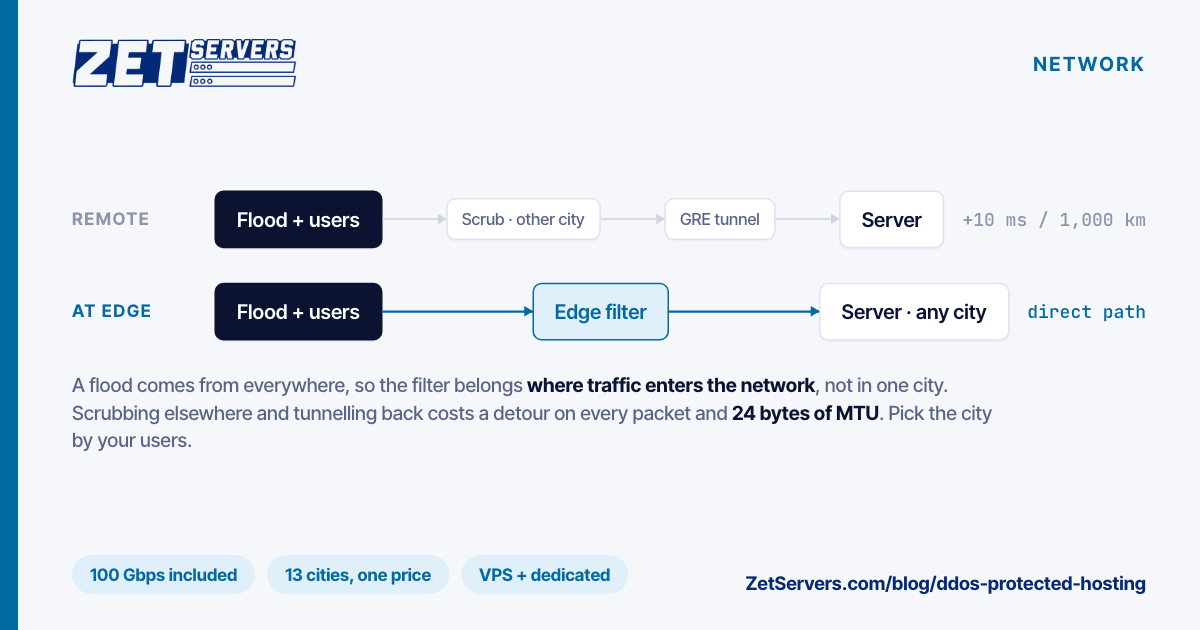
A botnet does not attack from your city. Its traffic comes from compromised devices and abused reflectors spread across many countries, and it reaches a provider's network at every point where that network connects to the rest of the internet. If filtering happens at those entry points, the flood is dropped where it arrives. Your server's city never has to carry it.
That is how our protection is built: attack traffic is dropped at our network edge, before it reaches the port of the server it was aimed at. The protection tier is an option on the product, not on the location, so the same tiers at the same prices are on sale in all 13 cities. Choosing Warsaw over Frankfurt does not buy you less protection.
Some providers work differently, and it is worth asking. A common design sends traffic to a scrubbing centre in another city, sometimes another country, and returns the clean part over a GRE tunnel. Two costs follow:
- Latency. Every inbound packet takes the detour. By the same rule we use for distances (kilometres ÷ 100 = round-trip floor in milliseconds), a scrubbing centre 1,000 km off the direct path adds about 10 ms to every round trip, before any processing.
- Packet size. GRE over IPv4 adds a 20-byte outer header and at least a 4-byte GRE header (RFC 2784), so a 1,500-byte path carries 1,476-byte packets inside the tunnel. Applications that assume 1,500 meet fragmentation or MSS clamping.
If the scrubbing only switches on during an attack, both costs arrive at the moment you are already under load.
Where you can buy DDoS protected hosting from us
Dedicated servers are sold in all 13 cities. KVM VPS is sold in eight. The location is a free choice at checkout, and prices are the same everywhere.
| City |
Dedicated |
VPS |
Close to (round-trip floor) |
| Frankfurt |
yes |
yes |
Cologne 1.5 ms, Munich 3.0 ms, Berlin 4.2 ms |
| Amsterdam |
yes |
yes |
Brussels 1.7 ms, London 3.6 ms, Hamburg 3.7 ms |
| Paris |
yes |
yes |
Lille 2.0 ms, Brussels 2.6 ms, London 3.4 ms |
| Marseille |
yes |
no |
Nice 1.6 ms, Lyon 2.8 ms, Algiers 7.5 ms |
| Madrid |
yes |
yes |
Valencia 3.0 ms, Seville 3.9 ms, Porto 4.2 ms |
| Lisbon |
EPYC only |
no |
Porto 2.7 ms, Funchal 9.7 ms |
| Milan |
yes |
yes |
Turin 1.3 ms, Zurich 2.2 ms, Rome 4.8 ms |
| Vienna |
yes |
yes |
Bratislava 0.5 ms, Budapest 2.1 ms, Prague 2.5 ms |
| Warsaw |
yes |
no |
Kraków 2.5 ms, Vilnius 3.9 ms |
| Bucharest |
yes |
yes |
Brașov 1.4 ms, Cluj-Napoca 3.2 ms, Istanbul 4.5 ms |
| Sofia |
yes |
no |
Skopje 1.7 ms, Belgrade 3.3 ms, Athens 5.3 ms |
| Dublin |
yes |
yes |
Manchester 2.7 ms, Edinburgh 3.5 ms |
| Ashburn (US) |
yes |
no |
New York 3.5 ms, Toronto 5.4 ms, Chicago 9.1 ms |
The floors are great-circle distance ÷ 100: the round trip light needs in fibre over the straight line. Real routes are longer. Multiply by 1.3 to 1.5 and add a millisecond or two for a working estimate, then measure the real path with mtr before you commit. Choosing a server location covers the method in full.
Choose the city by your users, not by the attacker
Since the filter is the same everywhere, the city decides only what it decided before you thought about attacks: how close the server is to the people using it, and which country's law it sits under.
A few patterns from the table. Germany, Switzerland and Austria are all within a few milliseconds of Frankfurt, but Vienna is the better base for Budapest, Prague and Bratislava. London is closer to Paris (3.4 ms) and Amsterdam (3.6 ms) than to Frankfurt (6.4 ms), and northern Britain is closest to Dublin. Southern France and North Africa sit nearer Marseille than Paris. Bucharest and Sofia are 3.0 ms apart and split the Balkans between them: Sofia for Skopje, Belgrade and Athens, Bucharest for Moldova and Istanbul. North America is Ashburn's, and for one transatlantic server Dublin is the European city nearest New York (51.1 ms floor against 58.6 ms from Amsterdam).
For a game server or a voice service, where players notice every millisecond, the latency floor should decide the city. For a website behind a CDN, latency to the CDN matters more than latency to visitors, and the deciding factor may be the jurisdiction your contracts or customers expect.
One city or two
A single protected server handles the common case: an attack inside its tier is filtered and the service stays up. What it cannot cover is the failure of the city itself, a power or upstream incident in one facility, or an attack big enough that the address is null-routed above its tier. Each of those removes one address in one place.
A second server in a second city turns that into a partial outage. Two addresses in two failure domains, with DNS or your application deciding which one users reach. Pairs that work well:
| Pair |
Distance |
Floor between them |
| Frankfurt + Amsterdam |
363 km |
3.6 ms |
| Bucharest + Sofia |
295 km |
3.0 ms |
| Madrid + Lisbon |
502 km |
5.0 ms |
| Paris + Marseille |
661 km |
6.6 ms |
| Ashburn + Dublin |
5,462 km |
54.6 ms |
Close pairs can replicate a database synchronously, or nearly so. Distant pairs suit an active-active setup where each city serves its own region and takes over the other's users when needed. Keep in mind what the second city does not do: an attacker who is aiming at your hostname can follow a DNS change to the new address. Failover protects against losing a place. The filter protects against the flood.
VPS or dedicated
The protection tiers are identical on both. The difference is what sits behind the filter. A KVM VPS from €29 a month gives you a dedicated vCPU, NVMe storage and a guaranteed 1 Gbps, and is enough for a small game community, a VPN exit, a mail server or a website. A dedicated server gives you the whole machine and a guaranteed port from 1 Gbps upwards, which matters once legitimate traffic, not attack traffic, is the thing filling the pipe. Choosing a DDoS protected VPS covers where the line falls.
What DDoS protected hosting costs with us
Prices in euros per month, excluding VAT, the same in every city:
| Server |
Included 100 Gbps |
With 500 Gbps |
With 1 Tbps |
| KVM VPS, 1 vCPU, 4 GB, 1 Gbps |
€29 |
€178 |
€528 |
| 1 Gbps dedicated, dual Xeon E5-2630 v4, 128 GB |
€209 |
€358 |
€708 |
| 1 Gbps dedicated, AMD EPYC 9254, 128 GB DDR5 |
€449 |
€598 |
€948 |
| 10 Gbps dedicated, dual Xeon E5-2630 v4, 128 GB |
€659 |
€808 |
€1,158 |
A second city costs a second server; the location option itself is free. If you have no attack history to size from, the included tier is a reasonable start, and the sizing table in the dedicated server guide shows which profiles tend to need more.
Frequently asked questions
What is DDoS protected hosting?
DDoS protected hosting is a VPS or dedicated server whose provider filters attack traffic in its own network before it reaches the server's port, forwarding only clean traffic. It is sold by capacity, for example 100 Gbps or 1 Tbps, and by layer: network-layer filtering stops floods, while Layer 7 filtering also handles HTTP request floods.
Is the DDoS protection the same in every location?
With us, yes. The protection tier is an option on the server, not on the city, and filtering happens at our network edge before traffic reaches the server. The same tiers, from 100 Gbps included to 10 Tbps with Layer 7, are sold at the same prices in all 13 cities.
Which city is best for DDoS protected hosting in Europe?
The one closest to your users, because the protection does not change between cities. Frankfurt suits Germany and central Europe, Amsterdam and Paris suit Benelux and London, Madrid suits Spain, Vienna suits central-eastern Europe, and Bucharest and Sofia suit the Balkans. Measure the route with mtr before you order.
Do I need DDoS protected servers in more than one city?
Not for most attacks: one server inside its protection tier stays online. A second city covers what a filter cannot, such as a facility outage or an address null-routed above its tier. Pairs a few milliseconds apart, like Frankfurt and Amsterdam, can share a replicated database and take over each other's traffic.