A Marseille dedicated server is the one European location that faces south and east rather than inward. Marseille, on France's Mediterranean coast, is where many of the subsea cables from Africa, the Middle East and Asia come ashore, so a server there sits at the European end of those routes rather than a thousand kilometres inland from them. For an audience in North Africa, the eastern Mediterranean or the Gulf, or for a European service that also needs to reach those regions, it is often the best seat on the continent. This guide covers why, the latency it buys, and the workloads that suit it.
Why Marseille matters
Subsea cables need a landing station, and Marseille has become one of the most important on the Mediterranean. Systems such as 2Africa, PEACE and AAE-1 land there, linking Europe with Africa, the Middle East and Asia. Traffic heading for those regions from anywhere in Europe tends to travel to the Mediterranean coast first; a server in Marseille starts its journey at that point.
The city also has a growing interconnection scene of its own: France-IX and DE-CIX both run internet exchanges there, and the cable traffic has drawn content networks and carriers to its data centres.
For a buyer, that translates into two practical advantages: shorter paths to users on the far side of the Mediterranean, and a well-connected French location that is not Paris.
The latency floor from Marseille
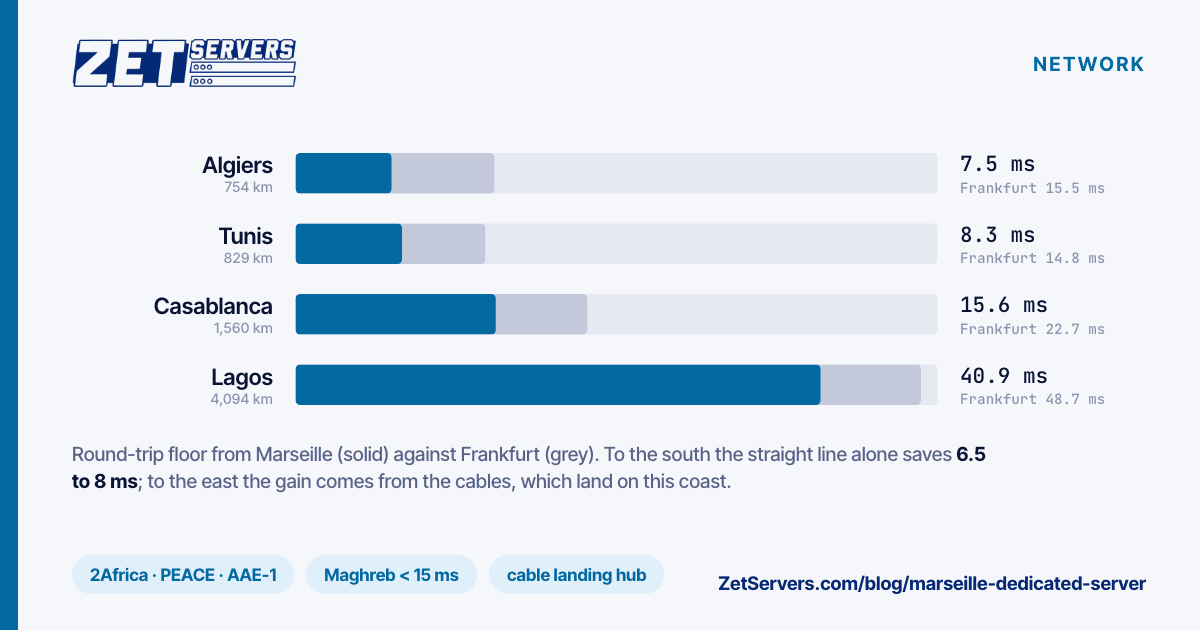
The method is the same as everywhere in this series — straight-line distance divided by 100 for the round-trip floor, then 30 to 50% more for real cable routes plus a little router delay. For destinations across the sea, the cable route rather than the straight line sets the real figure, so treat the long-distance estimates as rough:
| From Marseille to |
Great-circle |
Theoretical floor |
Working estimate |
| Milan |
387 km |
3.9 ms |
6–8 ms |
| Paris |
661 km |
6.6 ms |
10–12 ms |
| Algiers |
754 km |
7.5 ms |
11–13 ms |
| Madrid |
816 km |
8.2 ms |
12–14 ms |
| Tunis |
829 km |
8.3 ms |
12–14 ms |
| Casablanca |
1,560 km |
15.6 ms |
21–25 ms |
| Cairo |
2,721 km |
27.2 ms |
36–43 ms |
| Tel Aviv |
2,853 km |
28.5 ms |
38–45 ms |
| Lagos |
4,094 km |
40.9 ms |
54–63 ms |
| Dubai |
4,922 km |
49.2 ms |
65–76 ms |
| Mumbai |
6,765 km |
67.6 ms |
89–103 ms |
Compare those with Frankfurt, and the table splits in two. To the south — Algiers, Tunis, Casablanca, Lagos — Frankfurt is 650 to 800 km further away, which adds 6.5 to 8 ms to the floor of every round trip before routing is counted. To the east — Cairo, Tel Aviv, Dubai, Mumbai — the straight-line distances from the two cities are within about 200 km of each other, and the difference comes from the cables instead: the systems that carry that traffic come ashore on the Mediterranean, so a packet from Frankfurt usually travels down to the coast before it can head east. A Marseille server skips that leg. The Frankfurt guide covers what Frankfurt does better; reaching south of the Mediterranean is not one of them.
Workloads that fit Marseille
Services for North Africa. Algeria, Tunisia and Morocco together have a large, French-speaking online population, and Algiers and Tunis are under 15 ms from Marseille. A French-language media site, a game server or a streaming service aimed at the Maghreb is well placed here, with the data inside the EU.
Video for the Mediterranean and beyond. Video is the heaviest traffic most services ever carry, and it rewards a short path: fewer round trips per segment request, faster start-up, fewer quality drops. A Marseille origin can feed southern France, Italy, Spain and North Africa from one place. Our video on demand setups pair dense storage with a large port, and concurrent viewers per server shows how to translate a port speed into an audience size.
A Europe-plus-Middle-East footprint. A service with users in both Europe and the Gulf can run its European node in Marseille, at the European end of the cables those users' traffic travels on, rather than an overland leg further away.
A second French location. For a French audience, Paris and Marseille together give a northern and a southern node 661 km apart: separate failure domains in the same country and under the same legal regime.
Sizing a Marseille server
Delivery workloads aimed at a wide region are where the port size decides everything. A rough rule for video:
peak egress (Gbps) = peak concurrent viewers × average bitrate (Mbps) ÷ 1,000
Four thousand concurrent viewers at 5 Mbps is 20 Gbps at the peak — the case a 20 Gbps dedicated server is built for, and about 6.5 PB a month if held at full rate. On an unmetered plan the month total does not appear on the invoice, so size for the peak and leave headroom for the evening the audience doubles.
Long paths have one more cost: a single TCP connection's throughput is limited by its window divided by the round-trip time. At 70 ms to the Gulf, a connection needs a much larger window to fill a fast link than it does at 10 ms. For downloads and video served over many parallel connections that rarely matters; for single large transfers to distant users, check your kernel's TCP buffer limits.
What a Marseille dedicated server costs
Marseille is a free option at checkout, so it is priced like our other 12 cities. Entry prices for the tiers that fit regional sites and video delivery:
Bigger builds, up to dual EPYC, are available on each tier. Select Marseille in the location selector on the tier's page; most in-stock builds are online within an hour. The unmetered dedicated server buyer's guide compares all nine tiers by cost per delivered terabyte.
When Marseille is the wrong choice
Audiences in northern or eastern Europe. Warsaw, Stockholm and London are all much closer to Frankfurt or Amsterdam.
A single origin for the whole of Europe. Marseille sits at the southern edge of the continent; a central location keeps the worst-case user closer.
Users who are mostly in Asia. For an audience in Singapore or Tokyo, a server in Asia beats any European location by a wide margin. Marseille is the best European seat for those routes, not a substitute for being there.
Frequently asked questions
Why choose a Marseille dedicated server over Paris?
Paris is better for northern France and the Benelux. Marseille is closer to northern Italy, Spain and North Africa, and it is where the subsea cables to Africa, the Middle East and Asia come ashore. Many French services use both.
What latency can I expect from Marseille to North Africa?
Algiers and Tunis are about 750 to 830 km away, with round-trip floors near 8 ms and working estimates of 11 to 14 ms. Real figures depend on which cable carries the traffic, so measure from the target market before committing.
Is a Marseille server inside the EU?
Yes. Marseille is in France, so data on the server is stored inside the EU under GDPR, with the same legal position as a server in Paris or Frankfurt.
Does Marseille cost more than other locations?
No. A Marseille server starts at €209 a month for 1 Gbps guaranteed, as in every other city we sell; a 20 Gbps video origin starts at €1,159. Availability of a specific build can differ between cities.