A DDoS protected server in the USA, from us, means one place: Ashburn, Virginia, the only American city among our 13 locations. It is sold as a dedicated server only; we have no VPS in the US. Below: the 2026 attack data, who Ashburn reaches, which tier fits, and what US guidance expects.
The US is the most-attacked market again
Cloudflare's DDoS threat report for Q3 2026, published on 29 October, ranks the United States as the most-attacked location of the quarter, taking the top spot back from China; over the first half of the year it was second. Two figures matter to a server buyer:
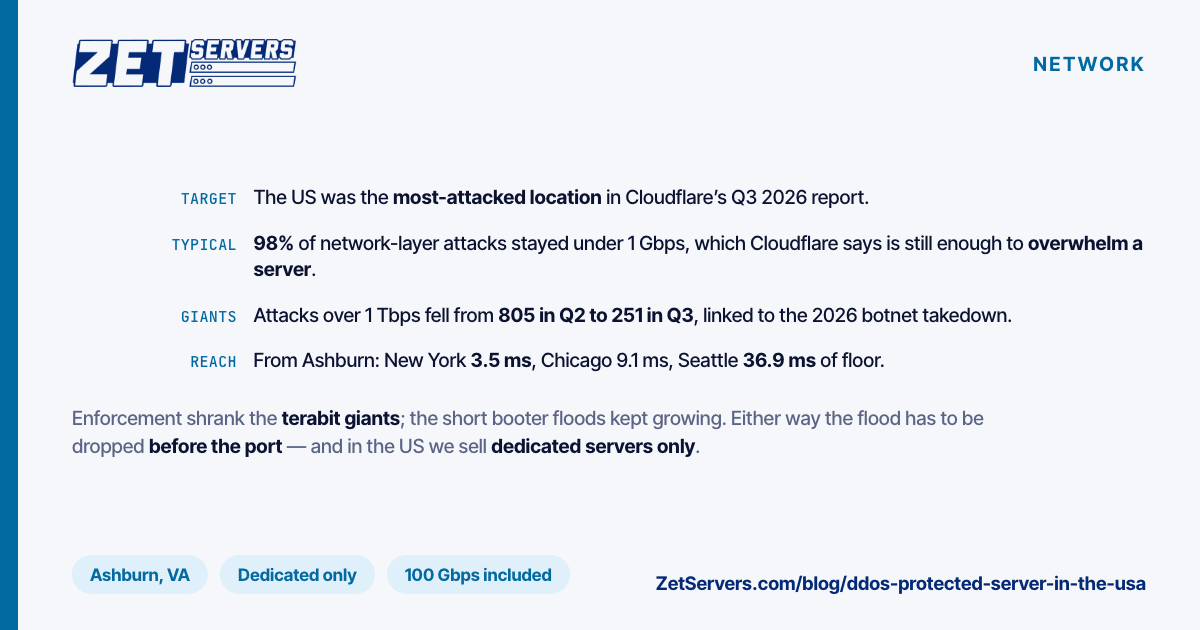
- 96% of network-layer attacks ended in under 10 minutes, and 98% stayed under 1 Gbps. Cloudflare still calls that enough to overwhelm a server; near 1 Gbps, one attack fills our smallest port.
- Attacks above 1 Tbps fell from 805 in Q2 to 251 in Q3. Cloudflare links the drop, cautiously, to the takedown of four IoT botnets described below.
Cloudflare reads the short, high-count pattern as the signature of DDoS-for-hire "booter" services, aimed mostly at software, gambling and IT companies.
Operation PowerOFF: what US enforcement has changed
Booters, also sold as "stressers", rent out attack capacity by subscription. Prosecutors in Anchorage and Los Angeles have been seizing them in waves, now under Operation PowerOFF, an international effort Europol supports:
| Date |
US action |
| Dec 2018 |
15 booter domains seized, 3 people charged |
| Dec 2022 |
48 domains seized, 6 charged |
| May 2023 |
13 domains, 10 of them relaunches of services seized in December |
| Dec 2024 |
27 domains seized, 2 charged |
| Mar 2026 |
Command servers of the Aisuru, KimWolf, JackSkid and Mossad IoT botnets disrupted |
| Apr 2026 |
8 domains seized in Alaska, alongside a Europol action week in 21 countries |
| Sep 2026 |
NightmareStresser domains seized; hundreds of thousands of attacks since 2022 |
The Justice Department's own tally in September: twelve defendants charged and more than 100 domains seized over eight years. The March operation matters most for sizing: according to the DOJ, some attacks from those four botnets measured about 30 Tbps, and together they had infected more than three million devices, hundreds of thousands of them in the United States.
Enforcement has not ended the market: relaunches keep appearing, and in Q3 the booter pattern grew while the giants shrank. A 2023 seizure affidavit quoted by the DOJ puts the economics bluntly: overprovisioning or buying protection is "usually significantly more expensive than the cost of a given booter service." Three sweeps came just before Christmas, a period the DOJ says typically brings a significant increase in attacks. Running game servers for North America? Size your tier before then.
Ashburn: one US location, dedicated only
Every DDoS protected server in the USA that we sell is in Ashburn, northern Virginia, on the east coast, and every one is dedicated. Our KVM VPS runs in eight European regions, so a project that would fit a €29 VPS in Europe starts at a €209 dedicated server here.
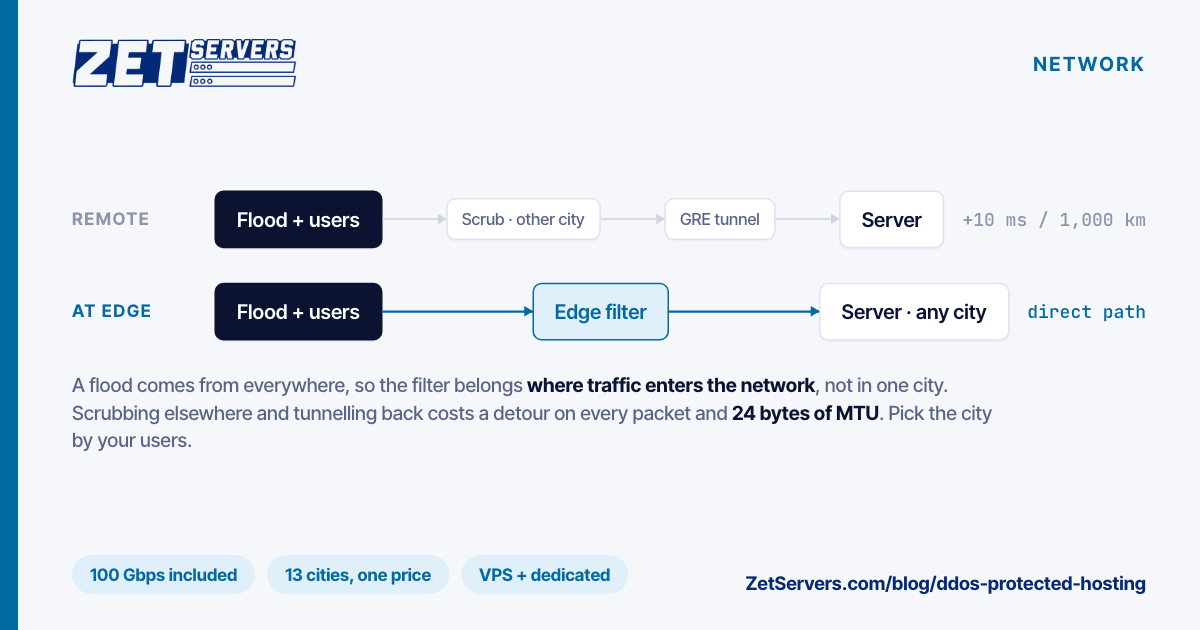
Protection is a property of the server, not the city, so Ashburn gets the same tiers at the same prices as Frankfurt. Filtering runs at our network edge: a flood is dropped where it enters our network, not hauled to Virginia first. Builds on the shelf usually go live within an hour of payment.
Who a DDoS protected server in the USA reaches from Ashburn
Floors are straight-line distance ÷ 100, in milliseconds of round trip; estimates scale that by 1.3 to 1.5 and add 1 to 2 ms for real routes. Run mtr from your users' networks before committing.
| From Ashburn to |
Floor |
Estimate |
Our nearest European city |
| New York |
3.5 ms |
6–7 ms |
Dublin, 51.1 ms |
| Chicago |
9.1 ms |
13–16 ms |
Dublin, 58.9 ms |
| Denver |
23.6 ms |
32–37 ms |
Dublin, 70.8 ms |
| Los Angeles |
36.5 ms |
48–57 ms |
Dublin, 83.0 ms |
| Seattle |
36.9 ms |
49–57 ms |
Dublin, 72.8 ms |
| Mexico City |
30.1 ms |
40–47 ms |
Dublin, 84.7 ms |
| Bogotá |
38.3 ms |
51–59 ms |
Lisbon, 75.2 ms |
| São Paulo |
76.6 ms |
101–117 ms |
Lisbon, 79.5 ms |
The east and the Midwest are Ashburn's: New York, Toronto (5.4 ms) and Chicago sit within about 10 ms of floor. The west is not. Los Angeles and Seattle are about 37 ms of floor away, 50 ms or more in practice: fine for a website or an API, noticeable in a competitive shooter. We have no west-coast city, and for an audience mostly on the Pacific coast, a provider with servers there will beat us on latency.
Latin America is the surprise: Mexico City and Bogotá are 30 and 38 ms of floor from Ashburn and 75 ms or more from any European city we sell. São Paulo is close to a tie with Lisbon, so measure first.
Sizing and pricing for US buyers
Choosing a tier for a DDoS protected server in the USA starts from that Q3 distribution. The included 100 Gbps tier is a hundred times a 1 Gbps port, which covers the booter-scale floods that make up most of the data. Gambling and gaming, both named among booter targets, are where a bigger tier earns its cost; the DDoS protected dedicated server guide matches tiers to profiles.
The entry 1 Gbps build (dual Xeon E5-2630 v4, 20 cores, 128 GB) costs €209 a month including the 100 Gbps tier, €358 with 500 Gbps or €708 with 1 Tbps. A 10 Gbps port starts at €659, and the top tier, 10 Tbps with Layer 7 filtering, is €4,499 a month.
Prices are in euros and exclude VAT; if you pay in dollars, the conversion rate is your bank's. The contract is with INTERKVM HOST SRL, registered in Lipova, Arad, Romania, so even a server in Virginia is bought from an EU company.
What CISA expects, and what CIRCIA will require
The joint CISA, FBI and MS-ISAC guide, Understanding and Responding to Distributed Denial-of-Service Attacks, is written for government bodies, but its checklist reads like a server runbook: baseline normal traffic, engage a mitigation provider, write a response plan; during an attack, tell your hosting provider and keep timestamps, IP addresses and packet captures; report it to an FBI field office or to CISA. Reflected attacks, it notes, typically come from legitimate public servers, so blocking sources on the box rarely helps.
CIRCIA, the Cyber Incident Reporting for Critical Infrastructure Act of 2022, will require covered critical-infrastructure entities to report covered cyber incidents to CISA within 72 hours and ransom payments within 24. The statute names disruption due to a denial-of-service attack, and CISA's 2024 proposed rule gives a DDoS that leaves a service unavailable to customers for an extended period as a typical reportable case. The final rule is not out: CISA held town halls in June 2026, and until it takes effect, reporting is voluntary. CIRCIA sets reporting duties, not a protection product. This is a summary, not legal advice.
Ashburn plus Europe
For users on both sides of the Atlantic, run a protected server on each. Ashburn is 54.6 ms of floor from Dublin and 62.1 ms from Amsterdam; each city serves its own continent and can take the other's users during an outage. Size each tier separately: Europol's April 2026 PowerOFF release notes that attacks are often regionally focused, with users targeting servers on their own continent. If EU personal data will sit in Virginia, the Ashburn dedicated server guide covers the GDPR transfer question.
Frequently asked questions
Do you sell a DDoS protected VPS in the USA?
No. Our only US location, Ashburn in Virginia, is sold as dedicated servers only, from €209 a month with the 100 Gbps tier at no extra cost. KVM VPS plans, from €29 a month with the same protection tiers, run in eight European regions.
What does a DDoS protected server in the USA cost?
The entry 1 Gbps dedicated server in Ashburn is €209 a month, and network-layer filtering up to 100 Gbps comes with it. A 500 Gbps tier adds €149 a month; the largest, 10 Tbps with Layer 7, adds €4,499. All prices are in euros without VAT, identical to our European cities.
Is Ashburn fast enough for users on the US west coast?
For websites, APIs and downloads, usually; for competitive games, test first. The round-trip floor from Ashburn to Los Angeles is 36.5 ms and to Seattle 36.9 ms, so real paths tend to land between 48 and 57 ms. New York, at 3.5 ms, and Chicago, at 9.1 ms, are far closer.
Do I have to report a DDoS attack in the United States?
Not yet under CIRCIA: its final rule had not taken effect by November 2026, and reporting to CISA stays voluntary until it does. Once it applies, covered critical-infrastructure entities will have 72 hours to report covered incidents. CISA and the FBI already ask victims to report DDoS attacks to an FBI field office or to CISA.