Colocation pricing is never one number. A quote is six or seven line items billed in different units, per rack, per kilowatt or kilowatt-hour, per circuit, per megabit and per quarter-hour, and two offers that look close can end far apart at your real power draw. This guide takes a quote apart line by line, prices power with arithmetic you can redo, and ends with a formula that puts two quotes, and renting, on the same footing.
The line items in a colocation quote
Most colocation, ours included, is sold on a quote, so the first job is knowing what each line measures and what to ask about it:
| Line |
Usually billed as |
Ask |
| Space |
per U, quarter, half or full rack, cage |
the power allowance that comes with it |
| Power |
committed kW, metered kWh, or both |
whether cooling is inside the rate |
| Cross-connects |
setup + monthly, per circuit |
how many are included |
| IP transit |
flat port, commit + burst, or per TB |
which direction is billed |
| IPv4 |
per subnet, setup + monthly |
whether your own prefix can replace it |
| Remote hands |
per hour or per increment |
the minimum increment |
| Term |
months to years |
the notice period and any price indexation |
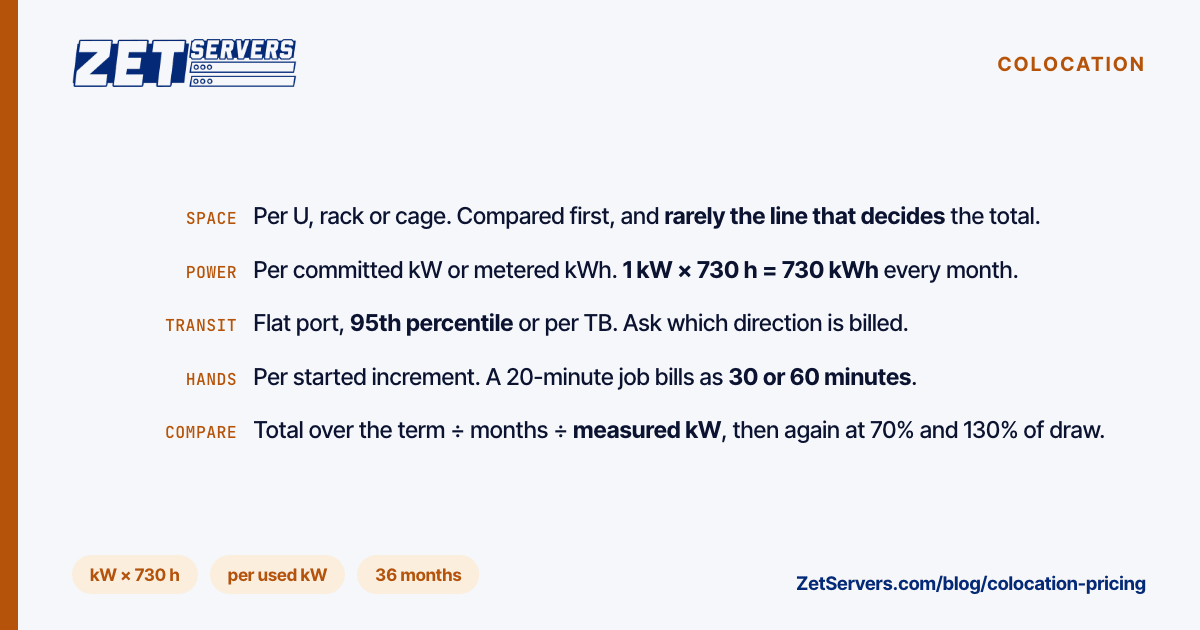
Space is the line people compare first, and rarely the one that decides the total. Where this guide needs a rate to show the arithmetic, it uses a round example and says so; replace it with the rate in your own quote.
Power: the line that sets colocation pricing
A month averages 730 hours: 8,760 hours in a year divided by 12. One kilowatt drawn around the clock is 730 kWh a month. At an example energy rate of €0.30 per kWh:
1 kW × 730 h =   730 kWh × €0.30 = €219 a month
4 kW × 730 h = 2,920 kWh × €0.30 = €876 a month
Space is billed once per rack; power grows with every server you add to it. Uptime Institute's Global Data Center Survey 2026, published in July, found that 4–5 kW is still the most common rack density in deployment, so a typical rack draws four to five times the first line every month. That is why, once a rack holds real load, power is usually the largest line on the invoice.
Power is sold in three ways:
- Metered. You pay per kWh drawn. Ask whether the rate includes cooling or whether IT energy is multiplied by a facility factor. The same survey puts the average PUE at 1.52; applied as a multiplier, 730 kWh of servers would bill as about 1,110 kWh.
- Committed. You buy an allowance in kW and pay for it whether you draw it or not. Large deployments are priced this way: CBRE's research for Q1 2026, published on 22 June, puts Frankfurt at up to €225 per kW per month for a 250–500 kW requirement, far beyond one rack but priced in the same unit. Ask whether energy sits inside the committed price or on top.
- Both. A committed allowance for the circuit, plus metered energy.
A quarter or half rack usually comes with a fixed power allowance, so a dense build can run out of kilowatts before it runs out of units. And A and B feeds are for redundancy: each must carry the whole load alone, so 5 kW on A+B is 5 kW of servers, not 10. The colocation checklist covers breaker derating and outlet types.
Measure before you ask; a power supply's label is a ceiling, not a reading. If the BMC supports DCMI, read it under real load:
ipmitool dcmi power reading
Cross-connects, transit and addresses
Cross-connects are physical circuits from your rack to a carrier, an exchange or another tenant, normally billed as a setup fee plus a monthly fee per circuit. Count every one, including a second transit link for redundancy.
IP transit arrives in one of three shapes:
- a flat port at a guaranteed rate, unmetered;
- a committed rate with burst above it, billed on the 95th percentile;
- volume, per terabyte. Cheap at low volume, it climbs linearly: a 1 Gbps port run flat out moves about 324 TB in a 30-day month, which at an example €1 per TB is €324.
Ask which direction is billed: a backup target fills its inbound side.
IPv4 addresses are a line of their own, billed per subnet, often with a setup fee as well as the monthly charge, and the larger the block the more it weighs on the total. If you hold a prefix and an ASN, a BGP session replaces that line, and the registry paperwork is in how to announce your own IP space. We accept customer prefixes over BGP on colocation.
Remote hands, setup and the term
Remote hands are billed by the increment, and the increment matters more than the rate. Billed per started 15 minutes, a 20-minute drive swap costs 30 minutes of time; billed per started hour, it costs 60, and three short visits a month bill three hours. Ask for the minimum increment, the out-of-hours rate, and whether racking on arrival counts as hands time.
Setup and receiving. Setup is a one-off per rack or circuit, so ask for it separately from the monthly price. Receiving has its own rules: ask whether the facility accepts parcels that need customs clearance, how long it stores them, and who pays to return one it refuses.
Term. Read the monthly price next to the term, the notice period, and whether the power rate is fixed or indexed to the energy market.
How to compare two colocation quotes
Put both on one footing: a total over the same term, at the draw you measured.
total = one-off fees + months × (space + power + cross-connects
                                 + transit + IPv4 + hands hours × rate)
cost per used kW per month = total ÷ months ÷ measured kW
Price power at your measured draw and transit at your own 95th percentile or terabytes. Then run it again at 70% and 130% of your draw. Committed power punishes the low case and metered power the high one; a quote that wins at both is the safer choice. Check that both count power the same way, per feed or in total. A Tier on a spec sheet describes the building, not the price, and data center tiers explains how to check one.
Break-even against renting
Our entry dedicated server, 2× Xeon E5-2630v4 with a guaranteed 1 Gbps port, is €209 a month; the single EPYC 9254 build on 1 Gbps is €449. Each price includes the hardware, power, cooling, transit and IPMI. Take a machine you metered at 300 W, at the same example €0.30 per kWh:
0.3 kW × 730 h = 219 kWh × €0.30 = €65.70 a month
€209 − €65.70  = €143.30 a month, about €5,159 over 36 months
That remainder has to buy the hardware and spares and cover the machine's share of rack, transit, addresses and hands. If the machine really moves a gigabit, per-terabyte transit at the example €324 already exceeds it. Repeat the sum for the €449 build at a metered 400 W and €361.40 a month is left, about €13,010 over 36 months. The more value packed into each kilowatt, the more room colocation has; the full model, labour included, is in colocation vs dedicated servers.
Our own colocation runs from a single U to a private cage, with A/B feeds and 24/7 remote hands. Send your space, measured draw, circuits and city through the colocation page and we reply with a quote the same day.
Frequently asked questions
How is colocation pricing calculated?
Colocation pricing is the sum of lines billed in different units: space per U or rack, power per committed kW or metered kWh, cross-connects per circuit, transit per port, percentile or terabyte, IPv4 per subnet, and remote hands per increment. Once a rack draws a few kilowatts, power is usually the largest line.
Why is power usually the biggest line in a colocation quote?
Because it is drawn every hour of the month. One kilowatt used continuously is 730 kWh, €219 a month at an example €0.30 per kWh, and the most common rack density, 4–5 kW, multiplies that four or five times. Space is billed once per rack; power grows with every server added.
Is metered or committed power cheaper?
Metered power is cheaper when your draw is low or variable, because you pay only for the kilowatt-hours used. Committed power suits steady racks and is how large deployments are priced. Model both at 70% and 130% of your measured draw, and check whether energy sits inside the committed price.
What should I ask before signing a colocation quote?
Ask whether the power allowance is per feed or total, whether cooling is in the rate, how many cross-connects are included, which direction and percentile transit bills on, the remote-hands increment, who receives shipments, the notice period, and whether the power price is fixed or indexed to the energy market.