Data center tiers headline many colocation spec sheets and are the least examined line on them. "Tier III" reads like a grade, as if Tier IV were simply better. Uptime Institute, which created the scheme, says otherwise: the four Tiers describe how a building's power and cooling behave during maintenance and failure. What a Tier does not describe is most of what keeps your servers online. Here is what each level means, the redundancy shorthand behind it, and how to check a claim.
The four Tiers, in Uptime's own words
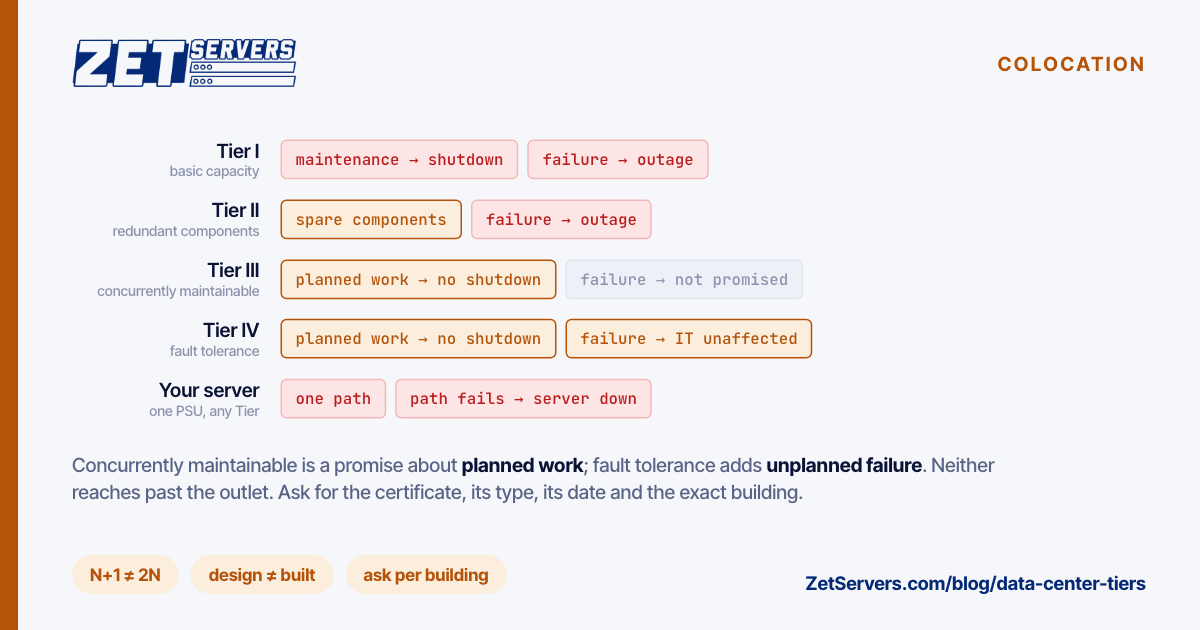
Uptime's Tier classification page calls the Tiers progressive: each includes the requirements of the Tiers below it.
| Tier |
Uptime's term |
Maintenance and failure |
| I |
basic capacity |
UPS, engine generator, dedicated cooling. The whole facility shuts down for preventive maintenance and repairs. |
| II |
redundant capacity components |
Spare generators, UPS modules, chillers and pumps. An unexpected shutdown still affects IT. |
| III |
concurrently maintainable |
Redundant components and distribution paths. Any part can be shut down for maintenance without affecting IT. |
| IV |
fault tolerance |
Independent, physically isolated systems. A failed component or interrupted path does not affect IT. |
The same page says the progression "does not mean that a Tier IV data center is better than a Tier II"; the levels fit different business needs.
N, N+1 and 2N in one example
In redundancy shorthand, N is the number of units needed to carry the load. Take a hall that needs 400 kW of cooling, served by 200 kW chillers:
N    = 400 / 200  = 2 chillers   no spare: one fails, the room runs short
N+1  = 2 + 1      = 3 chillers   one can fail or be serviced, capacity holds
2N   = 2 × 2      = 4 chillers   two independent systems, each carrying 400 kW alone
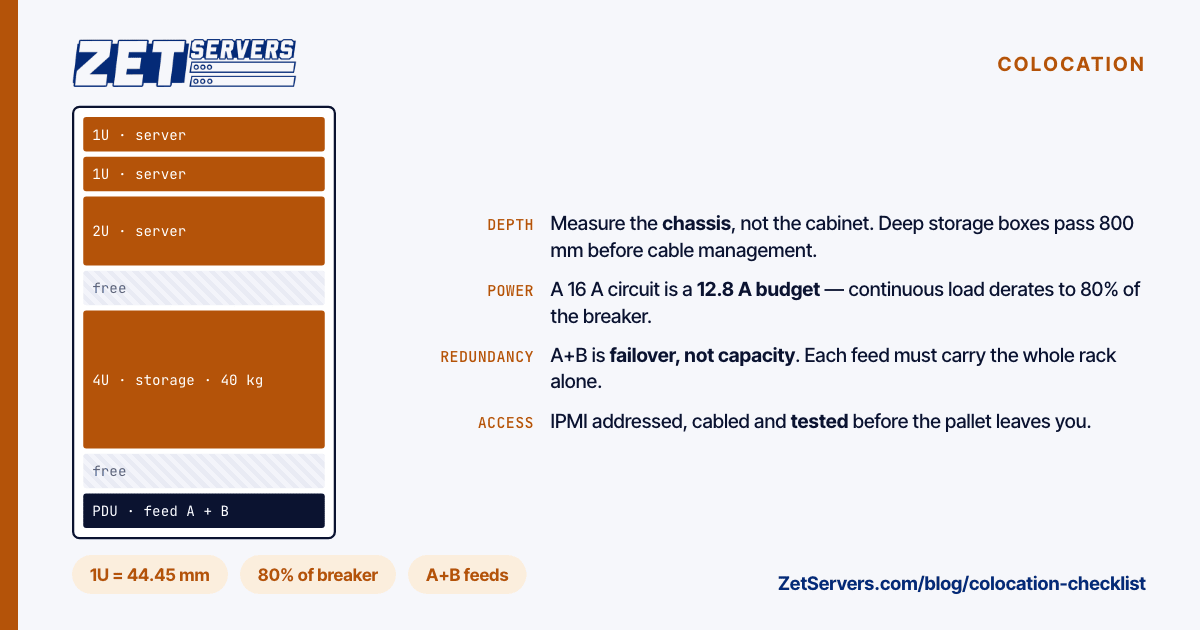
N+1 adds a spare component, not a spare path. If all three chillers share one set of pipework, that pipework is still a single point of failure. That is the gap between Tier II, which adds components, and Tier III, which adds distribution paths. 2N duplicates the whole system, close to what Tier IV describes. Uptime sets criteria, not equipment counts, so treat the mapping as a rule of thumb. What A and B power feeds mean for the kilowatts you can draw is in the colocation checklist.
Concurrently maintainable vs fault tolerant
Concurrently maintainable is about planned work. A UPS module is due for service. In a Tier III building the operator moves the load onto the other path, services the module and moves it back. IT keeps running because the work was scheduled.
Fault tolerant is about unplanned failure. The same module dies without warning at 03:00. Tier IV's definition says a failed component or an interrupted path does not affect IT. Tier III's definition covers maintenance, not surprises.
Uptime adds a caveat even for Tier IV: while redundant parts are down for maintenance, a failure carries a higher risk of disruption. Ask how much notice you get of maintenance windows.
Three different certificates
Uptime describes Tier Certification as covering design, construction and ongoing operations, as separate services:
- A design certificate says the drawings meet the Tier, not that the building was built to them.
- A constructed facility certificate says the building, as built, meets it.
- An operations assessment covers what Uptime calls operational sustainability: the management behaviour that keeps a building performing.
Uptime also states that it is the only licensed firm able to issue its Tier Certifications. So "Tier III designed", "compliant" or "equivalent" on a spec sheet is a description until someone shows you the certificate behind it. It may be honest, a design certificate only, or another scheme entirely.
Two other schemes on European spec sheets
ANSI/TIA-942 is an American National Standard from the Telecommunications Industry Association, specifying minimum requirements for data center infrastructure; revision C was published in May 2024. It grades resiliency as Rated-1 to Rated-4, and its scope is wider than Uptime's: alongside electrical and mechanical systems, it covers telecommunications, building architecture, fire safety, physical security and monitoring. TIA-licensed Conformity Assessment Bodies audit sites against it, and TIA lists conforming sites. A TIA-942 certificate and an Uptime Tier come from different bodies and are not interchangeable.
EN 50600 is the European standard series for data centre facilities and infrastructures, also published internationally as ISO/IEC 22237. It grades availability in classes 1 to 4, stepping from a single path up to fault-tolerant designs in a similar spirit to the Tiers, and it is audited by third-party certification bodies rather than by Uptime. A class is not a Tier, and neither converts into the other; ask the same four questions below of any of them.
Availability percentages
Spec sheets often put a percentage next to a Tier. Uptime's own Tier page gives none, so ask where any such figure came from. Work out what one allows from a year of 525,600 minutes (365 × 24 × 60):
99%      ->  1%     × 525,600 = 5,256 min   ≈ 87.6 hours a year
99.9%    ->  0.1%   × 525,600 =   525.6 min ≈ 8.8 hours
99.99%   ->  0.01%  × 525,600 =    52.6 min
99.999%  ->  0.001% × 525,600 =     5.3 min
A percentage says nothing about how downtime arrives: one 52-minute outage and fifty-two one-minute blips score the same. And a facility figure covers the facility, not your network, hardware or software.
What a Tier tells you nothing about
Uptime says its standards do not cover building codes, regional weather, security or property usage. A Tier is also silent on:
- Network. Which carriers are in the building and whether you can cross-connect to them. A Tier IV building with one carrier is a single point of failure with excellent cooling.
- Your hardware. Uptime's Tier IV definition says IT equipment needs a fault-tolerant power design. A single-PSU server sits on one path and goes down with it.
- Remote hands. Who answers at 03:00, how quickly, at what price.
- The SLA. The Tier is engineering; the SLA is the contract. Compare its credit with what an hour of outage costs you.
- Power per rack. Redundant power is not the same as enough of it.
- Location and law. These come from the city and the operator; see choosing a server location and EU data residency.
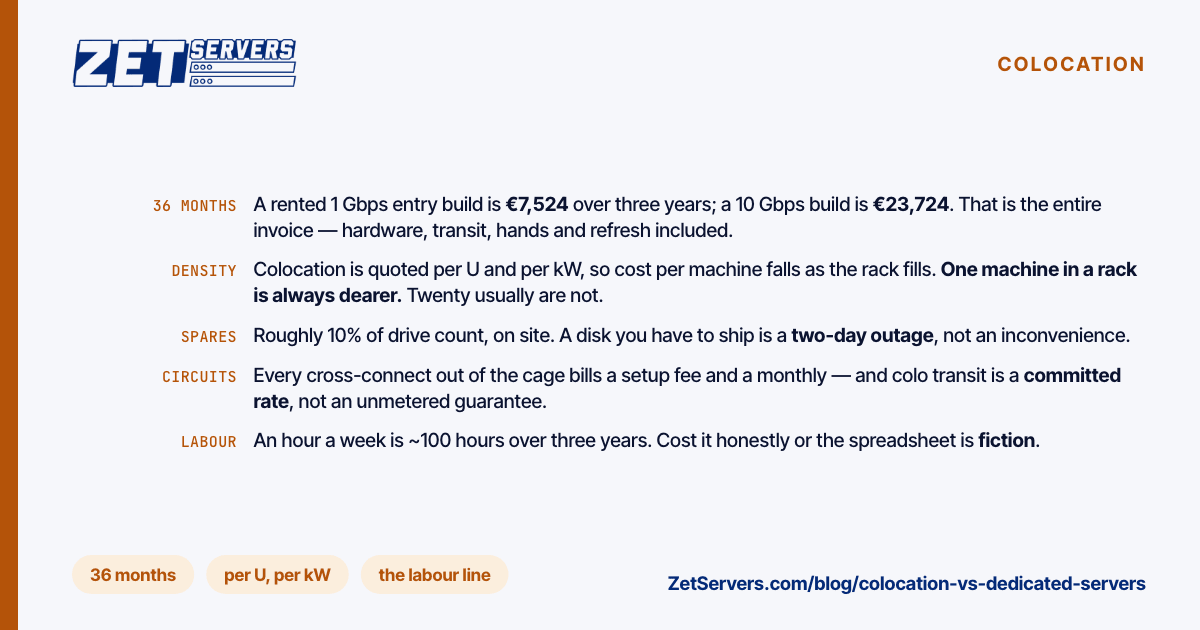
Whether to colocate at all is a separate calculation: colocation vs dedicated servers.
How to verify a Tier claim
- Who issued it? Uptime Institute, a TIA-licensed body, or the operator describing itself.
- What type is it? Design, constructed facility or operations.
- When was it issued? And has the building changed since?
- Which building does it name? A city, a campus or a brand is not a building.
Then check the issuer's public listing: Uptime publishes a Tier Certified site list, and TIA lists conforming data centers. If the building is not on the list, you have a description, not a certificate.
Our colocation, for reference
Our colocation page says we rack customer equipment in Tier III and Tier IV data centers and lists the buildings: Equinix and Interxion in Frankfurt, Amsterdam and Paris, NXData and Voxility in Bucharest, Telepoint in Sofia, and more. We will not summarise which building holds which certification; ask us for the certificate for the exact building you are quoted.
The page also describes A/B feeds from redundant UPS with generator backup, out-of-band access, 24/7 remote hands and cross-connects. There are no list prices; colocation is quoted per project (checked October 2026). Send us your hardware list, power draw and target city.
Frequently asked questions
What are data center tiers?
Data center tiers are Uptime Institute's four-level classification of a facility's power and cooling infrastructure. Tier I is basic capacity, Tier II adds redundant capacity components, Tier III is concurrently maintainable and Tier IV adds fault tolerance. Each Tier includes the ones below it, and Uptime says higher is not automatically better.
What is the difference between Tier III and Tier IV?
Tier III is concurrently maintainable: any component can be taken out for planned maintenance without shutting down IT. Tier IV adds fault tolerance, so an unplanned equipment failure or interrupted distribution path does not affect IT either. Tier IV only protects servers that have fault-tolerant power themselves, such as dual supplies on separate feeds.
Do data center tiers come with an uptime percentage?
Uptime Institute's Tier page assigns no percentage to any Tier; it defines them by how the facility behaves during maintenance and failure. Treat a percentage on a spec sheet as a claim that needs a source. To see what a figure allows: 99.99% of a year's 525,600 minutes leaves about 52.6 minutes of downtime.
Is "Tier III compliant" the same as Tier III certified?
No. Uptime Institute says it is the only licensed firm that can issue its Tier Certifications, so "compliant", "designed to" or "equivalent" describe a claim, not a certificate. Ask who issued it, whether it covers design, the built facility or operations, when, and for which building, then check the issuer's public list.
Does a Tier IV facility make my single-PSU server redundant?
No. The building's redundancy ends at the power outlet. A server with one power supply sits on one path, so when that path fails or is down for maintenance, the server goes down with it. Uptime's Tier IV definition expects fault-tolerant power in the IT equipment: in practice, dual supplies on A and B feeds.