An Ethereum node server has run two programs since the Merge on 15 September 2022: an execution client, which holds the state and executes transactions, and a consensus client, which follows proof of stake and tells the first which block is the head. Both publish hardware guidance, and one line in it decides most builds: the disk. This guide sizes full, archive and validator nodes, dating every disk figure because the chain only grows. It covers hardware only, not staking economics.
Two clients and the link between them
The main execution layer (EL) clients are Geth, Nethermind, Besu, Erigon and Reth; the consensus layer (CL) ones are Lighthouse, Prysm, Teku and Nimbus. You run one of each; Geth's docs say it cannot track the chain head without a consensus client.
The pair talk over the Engine API on port 8551, kept apart from public JSON-RPC and authenticated with a hex-encoded 256-bit secret both clients read. Each call carries an HS256 token whose timestamp must be within 60 seconds of the receiver's clock, so keep NTP running. Erigon is the exception, with its own consensus layer, Caplin, on by default.
sudo mkdir -p /secrets
openssl rand -hex 32 | tr -d "\n" | sudo tee /secrets/jwt.hex

geth --authrpc.addr localhost --authrpc.port 8551 \
     --authrpc.vhosts localhost --authrpc.jwtsecret /secrets/jwt.hex

lighthouse bn --network mainnet \
     --execution-endpoint http://localhost:8551 \
     --execution-jwt /secrets/jwt.hex \
     --checkpoint-sync-url https://mainnet.checkpoint.sigp.io
What the specifications ask for
EIP-7870, a living informational EIP from January 2025, sizes the combined EL and CL machine; ethereum.org repeats it:
|
Full node |
With validators |
| CPU |
4 cores / 8 threads, PassMark ~1,000 single-thread |
8 / 16, ~3,500 |
| RAM |
32 GB |
64 GB |
| Disk |
4 TB NVMe |
4 TB NVMe |
| Bandwidth down / up |
50 / 15 Mbps |
50 / 25 Mbps |
The Lighthouse book warns that 16 GB of RAM may run out of memory; Nethermind wants at least 10,000 IOPS for reads and writes.
Ethereum node server disk sizes, dated
Eth Docker, whose figures ethereum.org cites, measured each execution client on mainnet in September 2026. The history you keep now matters as much as the client:
| Client |
Full history |
Post-Merge only |
Rolling expiry |
| Besu |
>1.7 TiB |
~1.1 TiB |
~430 GiB |
| Erigon |
~1.6 TiB |
~1.1 TiB |
~590 GiB |
| Geth |
>1.7 TiB |
~1.3 TiB |
not supported |
| Nethermind |
~1.6 TiB |
~1.2 TiB |
~450 GiB |
| Reth |
~2 TiB |
~1.2 TiB |
~400 GiB |
Since July 2025 every execution client can drop pre-Merge history, 300–500 GB by the Ethereum Foundation's estimate; Geth's docs show geth prune-history taking a node from 1.27 TiB to 936 GiB. Consensus clients add 15 to 90 GiB (Eth Docker, April to September 2026).
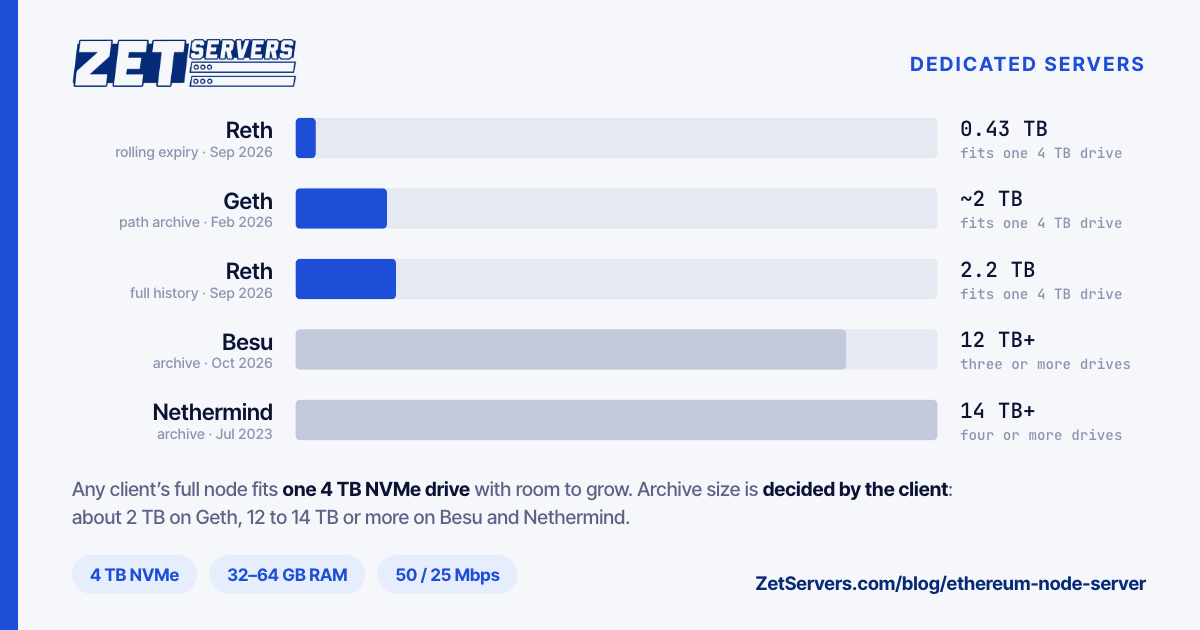
A 4 TB drive holds 3.64 TiB (4 × 10¹² ÷ 2⁴⁰). Reth's full history plus Nimbus, the largest of each, leaves about 1.5 TiB for growth and the periodic resync or prune Nethermind's docs describe.
Archive nodes keep every historical state; their size depends on the client. Geth's path-based archive is about 2 TB, or 6.5 TB with historical trie nodes for proofs (docs edited February 2026). Erigon's docs measured 2.25 TB on 17 September 2026, plus about 441 GB of receipts cache from version 3.7. Reth needs at least 2.8 TB (June 2025). Besu needs 12 TB or more and Nethermind at least 14 TB, a July 2023 figure that has grown since (ethereum.org, October 2026).
Why NVMe, and why a hard disk fails
EIP-7870 targets about 2,000 MB/s sequential, 50,000 random 4K read IOPS and 15,000 write IOPS, and advises against DRAM-less and QLC drives. Eth Docker is blunter: an HDD "will not be sufficient", and an execution client wants latency under 300 microseconds at worst.
A 7,200 rpm disk turns once every 8.3 ms, so even with zero seek time a random read waits 4.2 ms on average: at most about 240 operations a second, or over 200 spindles to reach 50,000. SATA's 6 Gbit/s leaves about 600 MB/s after 8b/10b encoding, under a third of the sequential target. NVMe vs SATA vs HDD covers the interfaces.
Eth Docker also advises against hardware RAID, which blocks TRIM; use an HBA and a software mirror for redundancy. Some clients can park cold data on slower disks (Geth's --datadir.ancient, Reth's static files), but the live state stays on NVMe. Test a delivered drive first with Eth Docker's checks:
sudo ioping -D -c 30 /dev/nvme0n1
fio --randrepeat=1 --ioengine=libaio --direct=1 --gtod_reduce=1 --name=test \
    --filename=test --bs=4k --iodepth=64 --size=150G \
    --readwrite=randrw --rwmixread=75; rm test
Benchmarking a new dedicated server has the full acceptance run.
CPU and RAM
Neither usually limits a full node: Eth Docker measured execution clients at 8–18 GiB of RAM and consensus clients at 5–14 GiB, and Erigon's Beacon API adds about 6 GB.
PassMark's ratings on 23 November 2026 put the EPYC 9254 at 2,998 single-thread and about 64,000 multi-thread, the Xeon E5-2690 v4 at 2,067 and 19,182. Against the validator figure of roughly 3,500 single-thread, the 9254 is about 14% short and the Xeon 41%. EPYC vs Xeon compares the families.
What validators change in hardware
Since PeerDAS arrived with the Fusaka upgrade on 3 December 2025, validators also load the consensus side. A node without validators custodies 4 of 128 data columns; with validators it custodies one per 32 ETH of attached balance, at least 8, and all 128 from 4,096 ETH, a "supernode". Teku's docs (November 2026) put blob data at about 16 GB for a plain node and 500 GB for a supernode at a 14-blob target. ethPandaOps' devnet data (October 2025) showed supernodes at 14 blobs near 100 Mb/s at baseline, with receive spikes near 400 Mb/s.
The Lighthouse book warns that validator keys must never run on two machines at once, which slashing protection cannot catch. Failover is a spare machine started after the first is stopped, not an active pair. Compare the far higher floors of a Solana validator server.
Bandwidth against a 1 Gbps port
A 1 Gbps port is twenty times EIP-7870's 50 Mbps download figure. One megabit per second sustained for 30 days is 0.324 TB (125,000 bytes/s × 2,592,000 s), so a validator node at the full EIP rates all month moves 16.2 TB in and 8.1 TB out, and a supernode at its devnet baseline 32.4 TB. On a metered plan those are invoices; on our unmetered 1 Gbps servers they cost what an idle port does. The EIP figures are capacity, not usage: measure yours with vnstat -m.
Ports and firewall
| Port |
Protocol |
Used by |
Expose |
| 30303 |
TCP + UDP |
execution clients |
public |
| 42069 |
TCP + UDP |
Erigon snapshot torrent |
public |
| 9000, 9001 |
TCP + UDP, UDP |
Lighthouse, Teku; Nimbus 9000 only |
public |
| 13000, 12000 |
TCP + UDP, UDP |
Prysm |
public |
| 8551 |
TCP |
Engine API |
localhost |
| 8545 |
TCP |
JSON-RPC |
trusted hosts |
With ufw for Geth and Lighthouse, 203.0.113.10 being your management address:
sudo ufw default deny incoming
sudo ufw allow from 203.0.113.10 to any port 22 proto tcp
sudo ufw allow 30303/tcp
sudo ufw allow 30303/udp
sudo ufw allow 9000/tcp
sudo ufw allow 9000:9001/udp
sudo ufw enable
Mapping it to our builds
For an Ethereum node server, the single EPYC 9254 fits: 24 cores, 128 GB of DDR5, twice the validator line, and 10 NVMe slots, from €449 a month at 1 Gbps. The listing shows slots, not fitted drives, so specify drives in the order: for a full node, two 4 TB TLC NVMe drives with DRAM in a software mirror, leaving eight slots for growth. A Besu or Nethermind archive needs four or more 4 TB drives, and Nethermind suggests 128 GB of RAM for one, all of the 9254's, so ask for more in the quote. Extra storage can lengthen delivery.
The Xeon E5 builds from €209 list SSD slots, not NVMe; if those are SATA they fall below EIP-7870's sequential target, so ask before planning a mainnet execution client on one. Several nodes fit the dual EPYC 9554: 24 NVMe slots and 512 GB, from €959.
Frequently asked questions
How much disk does an Ethereum node server need?
EIP-7870 recommends a 4 TB NVMe drive. Eth Docker measured full-history execution databases at 1.6 to 2 TiB in September 2026, or 1.1 to 1.3 TiB without pre-Merge history. Archives run from about 2 TB on Geth's path-based archive (docs, February 2026) to over 14 TB on Nethermind (July 2023).
Can an Ethereum node run on a hard disk or SATA SSD?
Not the execution client's live state. EIP-7870 targets about 50,000 random read IOPS and 2,000 MB/s sequential; a 7,200 rpm disk cannot exceed about 240 random operations a second, and SATA tops out near 600 MB/s. Some clients can move cold history to slower disks.
How much bandwidth does an Ethereum node use?
EIP-7870 recommends 50 Mbps down and 15 Mbps up for a full node, 25 Mbps up with validators. Each sustained megabit per second is 0.324 TB a month, so those ceilings mean about 16 TB in and 5 to 8 TB out. Supernodes, holding all blob data, ran near 100 Mb/s on a devnet.
Do I still need two clients to run an Ethereum node?
Yes. Since the Merge, a full node needs an execution client and a consensus client, linked by the JWT-authenticated Engine API on port 8551. Erigon is the main exception: it embeds its own consensus layer, Caplin, enabled by default, so one Erigon process can follow the chain alone.