A Dublin dedicated server puts your hardware on the western edge of the EU, in an English-speaking country that faces Britain on one side and the Atlantic on the other. That position makes Dublin a specialist rather than a default: it is the best of our locations for Ireland and for the north and west of Britain, and the European city closest to North America. It is not the best for London, and it does not replace a server in the United States. This guide covers who Dublin reaches well, what the latency floor looks like, which workloads fit, when another city wins and what it costs.
What Dublin is the hub for
Two facts about Ireland shape the case.
It is in the EU and it speaks English. A company that needs its primary data inside the EU, but whose customers, staff or support language are English, gets both in one place. Users in Ireland, Northern Ireland, Scotland and the north of England all sit a few milliseconds away.
It is the westernmost of our European cities. Every kilometre west is a kilometre closer to the east coast of North America. Dublin cannot beat a server in the US for American users, but for a single European server that also has to serve American visitors, it shortens the transatlantic leg more than any of our other European locations.
The latency floor from Dublin
The method is the same as in our other city guides. Light in fibre covers about 200 km per millisecond, so a round trip can never be shorter than the great-circle distance divided by 100. Real routes run longer than the straight line, so the working estimate multiplies the floor by 1.3 to 1.5 and adds a millisecond or two for routers:
| From Dublin to |
Great-circle |
Theoretical floor |
Working estimate |
| Belfast |
140 km |
1.4 ms |
3–4 ms |
| Cork |
220 km |
2.2 ms |
4–5 ms |
| Manchester |
267 km |
2.7 ms |
4–6 ms |
| Edinburgh |
350 km |
3.5 ms |
6–7 ms |
| London |
463 km |
4.6 ms |
7–9 ms |
| Amsterdam |
756 km |
7.6 ms |
11–13 ms |
| Paris |
781 km |
7.8 ms |
11–14 ms |
| Frankfurt |
1,088 km |
10.9 ms |
15–18 ms |
| Boston |
4,809 km |
48.1 ms |
64–74 ms |
| New York |
5,115 km |
51.1 ms |
67–79 ms |
| Toronto |
5,250 km |
52.5 ms |
69–81 ms |
| Ashburn |
5,462 km |
54.6 ms |
72–84 ms |
Choosing a server location explains the method and how to measure real paths before you commit.
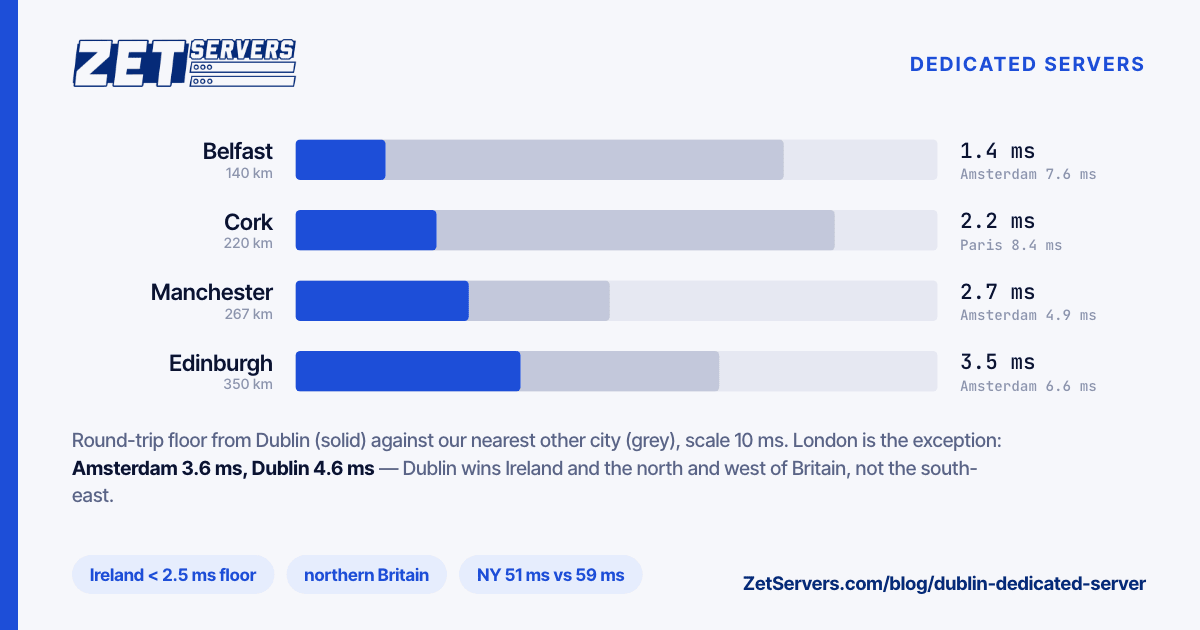
Against our other cities, three things stand out. Ireland itself is a short hop: Belfast and Cork are both under 2.5 ms of floor, against 7.6 and 9.1 ms from Amsterdam. The north and west of Britain favour Dublin too, with Manchester at 2.7 ms (Amsterdam 4.9) and Edinburgh at 3.5 ms (Amsterdam 6.6). London does not: Amsterdam's floor to London is 3.6 ms and Paris's is 3.4, both shorter than Dublin's 4.6. And across the Atlantic, Dublin's 51.1 ms to New York beats Amsterdam's 58.6 and Frankfurt's 62.0, which is the transatlantic argument in one line.
Workloads that fit Dublin
Services for Irish users. Shops, SaaS products and media aimed at Ireland are a millisecond or two from their audience, with data that stays inside the EU.
Britain outside London. A gaming community in Manchester or a service with users across Scotland sits closer to Dublin than to any continental city we offer. If your British audience is spread across the country rather than concentrated in the south-east, Dublin is worth testing.
One server for Europe and the US east coast. A small product with customers on both sides of the Atlantic, and budget for one machine, gets its shortest worst case from Dublin. American visitors still pay about 50 ms of floor, but that is 7 to 11 ms less than from Amsterdam or Frankfurt, and Paris, Amsterdam and Frankfurt stay within about 11 ms of floor.
A European origin with American users. Downloads, video catalogues or an API whose data must live in the EU, but whose traffic partly comes from North America, benefit from the shorter crossing.
When Dublin is the wrong choice
Your users are in North America. For an audience mostly in the US or Canada, a server there wins outright: Ashburn's floor to New York is 3.5 ms against Dublin's 51.1. The Ashburn dedicated server guide covers that side of the Atlantic; Dublin is the compromise for one server, not a replacement for two.
Your users are in London and the south-east. Amsterdam and Paris are both closer to London than Dublin is. For a London-heavy audience, those are the better starting points.
Your audience is continental. Frankfurt is 10.9 ms of floor from Dublin, and everything further east adds to it.
You need a second failure domain close by. Dublin pairs with Amsterdam, 756 km apart, for a standby near enough for fast replication. A Dublin and Ashburn pair, 54.6 ms apart, is the transatlantic version: slower replication, but each side serves its own continent.
Planning for the Atlantic round trip
If you choose Dublin for a split audience, plan for the long leg rather than hoping it disappears. A single TCP connection carries no more than its window divided by the round-trip time, so a transfer that looks fast in Europe can stall for an American user 70 ms away. Tune TCP buffers, reuse connections, and cache static assets near American users as their share grows.
A cold HTTPS page load needs several round trips before the first byte, so at 70 ms each, cutting round trips matters more than shaving the route. For a cheap test before committing, an unmetered KVM VPS from €29 a month is also sold in Dublin and makes a good probe or second node.
What a Dublin dedicated server costs
Dublin is a free option at checkout, so a Dublin dedicated server costs the same as in any of our other locations. Entry prices:
Larger builds go up to dual EPYC with 512 threads. Choose Dublin in the Location selector; stock differs by city, and most in-stock builds are online within an hour of payment. The unmetered dedicated server buyer's guide compares every tier by cost per delivered terabyte.
A practical Dublin checklist
- Map your users. Ireland, northern Britain and a transatlantic split favour Dublin.
- Measure, do not assume. Test from Manchester, London and New York before you order.
- Size the port for the peak, not the average, and remember that idle headroom on an unmetered port costs nothing extra.
- Pick a second city, Amsterdam for a close pair or Ashburn for one per continent.
- Send backups elsewhere, never to the same metro as the primary.
Frequently asked questions
Is Dublin a good location for UK users?
For Northern Ireland, Scotland and the north of England, yes: Manchester and Edinburgh are closer to Dublin than to Amsterdam. For London, Amsterdam and Paris are slightly closer.
Should I use a Dublin dedicated server for American users?
Only if you can run one server and most of your users are in Europe. Dublin's floor to New York is 51.1 ms, the shortest of our European cities, but a server in Ashburn is 3.5 ms from New York. For a mainly American audience, host in the US.
Is Dublin in the EU?
Yes. Ireland is an EU member state, so a Dublin server keeps the primary copy of your data inside the EU.
Does Dublin cost more than other locations?
No. A Dublin dedicated server starts at €209 a month with 1 Gbps guaranteed, the same as our other cities. What can differ is stock, so check the build you want is available in Dublin when you order.