The cost per terabyte of bandwidth is not a price anyone quotes you. It is a number you derive, and it comes out differently under each of the three ways hosting bandwidth is sold: a flat rate on a guaranteed port, a 95th percentile bill on a metered port, and a per-gigabyte charge on cloud egress. The same traffic can cost ten times more under one model than another, and the deciding variable is not volume — it is how evenly you use the pipe.
How many terabytes is one gigabit per second?
Start with the conversion everything else rests on. A saturated 1 Gbps link moves 125 MB per second:
125 MB/s × 86,400 s = 10.8 TB per day
10.8 TB × 30 days   = 324 TB per month
So 1 Gbps held flat out for a month is 324 TB. Multiply for any other rate: 10 Gbps is 3,240 TB, 100 Gbps is 32,400 TB. That last one is 32.4 PB, which is a useful sanity check the next time a spec sheet quotes petabytes without saying over what period.
What does a flat unmetered port cost per terabyte?
Cost per terabyte of bandwidth is the monthly price of a link divided by the terabytes it actually delivers — which makes it a number about your utilisation, not just about the contract.
On a flat plan you buy a rate. The bytes are free; the pipe is the product. Divide the monthly price by the terabytes the rate can carry and you get the floor cost for that tier:
| Tier |
From |
TB/month at 100% |
€ per TB at 100% |
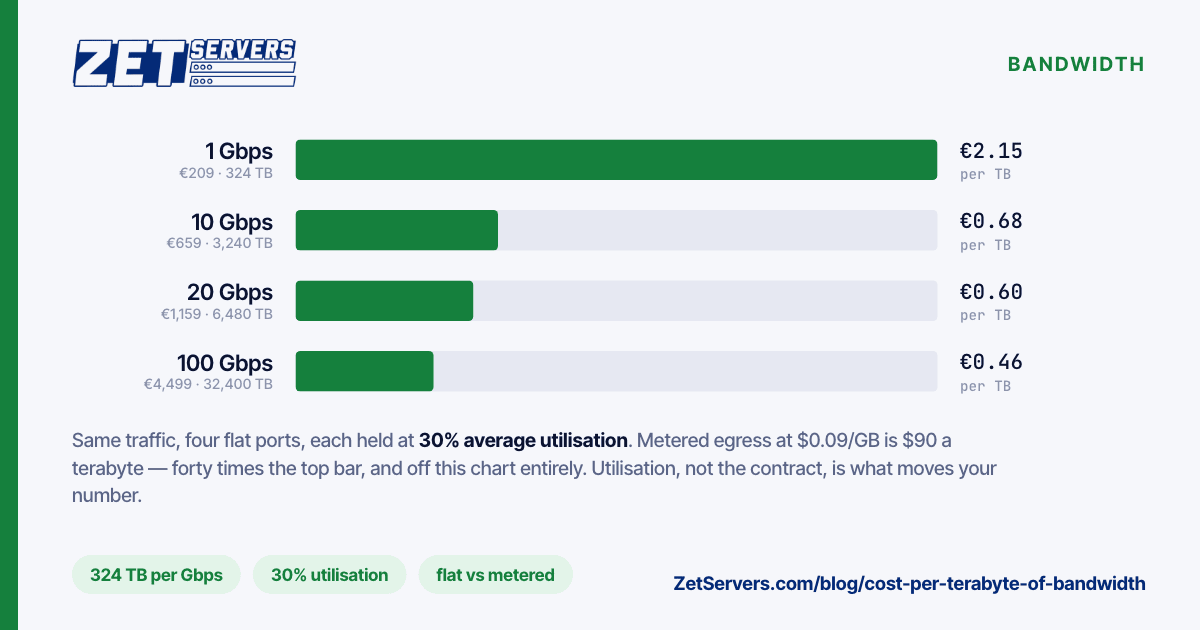
€ per TB at 30% |
| 1 Gbps |
€209 |
324 |
0.65 |
2.15 |
| 10 Gbps |
€659 |
3,240 |
0.20 |
0.68 |
| 20 Gbps |
€1,159 |
6,480 |
0.18 |
0.60 |
| 50 Gbps |
€2,799 |
16,200 |
0.17 |
0.58 |
| 100 Gbps |
€4,499 |
32,400 |
0.14 |
0.46 |
ZetServers list pricing, September 2026.
The last column is the honest one. Nobody runs a port at 100% — a delivery workload with a normal day/night curve averages 25–40% of its peak. Read the fourth column as the theoretical floor and the fifth as what you will actually pay.
When does 95th percentile billing cost less?
Under 95th percentile you buy a port and get billed on the rate you sustain, with the busiest 5% of samples discarded. It rewards spiky traffic and punishes plateaus.
A seedbox or a backup target sitting at a steady 2 Gbps pays for almost every bit of it. A service that spikes for two hours a night pays for a fraction of its peak. So percentile billing is cheaper exactly when your traffic is bursty and more expensive when it is flat — which is the opposite of most people's intuition about "paying for what you use".
The arithmetic is in 95th percentile billing, including how to compute your own billed rate from your own graphs before the invoice lands.
What does per-gigabyte cloud egress cost?
Cloud egress is priced by the byte. AWS lists $0.09 per GB for the first 10 TB a month out to the internet, after a 100 GB monthly allowance, with lower rates at higher volume tiers (AWS EC2 on-demand pricing, checked September 2026). At list, one terabyte costs $90.
Put that against the table above. A 1 Gbps dedicated server at €209 running at a modest 10% average — 32.4 TB a month — costs €6.45 per terabyte. The same 32.4 TB at $0.09/GB is $2,916.
Volume tiers and negotiated rates narrow that, and a hyperscaler sells more than transport. But the gap is an order of magnitude, not a percentage, and it is why high-egress workloads keep leaving metered platforms for flat ports.
Where is the break-even between flat and metered?
If you are quoted a per-terabyte price and a flat monthly price, the crossover is simple:
break-even TB = flat monthly price / metered price per TB
At €5 per TB metered against a €209 flat server, the break-even is 41.8 TB a month — about 13% utilisation of a 1 Gbps port. Above that, flat wins and keeps winning, because the flat line does not move when you grow.
This is also the argument for buying a rate above today's peak. Under metered billing, growth is a linear cost increase. Under flat billing, growth is free until you hit the port, and then it is one step change. Sizing that step is what choosing an uplink speed works through.
What the number hides
Utilisation is the whole game. Two customers on the same €1,159 20 Gbps server can pay €0.18 and €1.80 per terabyte. The difference is not the contract, it is the traffic shape. Before you price anything, pull your peak-to-average ratio out of your own graphs.
Inbound is usually free, and usually forgotten. Most ports are symmetric and most providers bill egress only. If your workload is ingest-heavy — backup targets, replication receivers, CDN origins being filled — your bandwidth bill may be far smaller than a naive terabyte count suggests.
A cheap terabyte on a congested path is not cheap. Cost per terabyte says nothing about whether those terabytes arrive promptly. A port that is oversubscribed upstream delivers retransmits, and retransmitted bytes are bytes you pay for twice while the user waits. This is why peering vs transit matters to a cost calculation and not only to a latency one.
"Unmetered" and "unlimited" are different claims. The first is about billing, the second is usually about a fair-use clause. What unmetered bandwidth actually means separates them properly; the short version is that a guaranteed rate with no traffic counter is a contract, and "unlimited" without a rate is a marketing word.
Working it out for your own traffic
Three numbers, ten minutes:
- Monthly terabytes delivered, from your current bill or your interface counters.
- Peak rate, from the busiest five-minute sample in your graphs — not the average.
- Peak-to-average ratio, the second divided by the mean rate.
Size the port to peak plus roughly 30% headroom, look up that tier's monthly price, and divide by your monthly terabytes. That is your real cost per terabyte on a flat plan, and it is directly comparable to whatever your metered provider charges. If it lands between two tiers, price both — the ladder is not linear, and the larger tier is sometimes the cheaper gigabit.
Frequently asked questions
What is a realistic cost per terabyte of bandwidth on a dedicated server?
Between roughly €0.14 and €2.20 per terabyte on our range, depending entirely on the tier and how full you keep it. The floor is €0.14 on a fully saturated 100 Gbps port; a lightly loaded 1 Gbps box lands near €2.
Does unmetered mean I can run the port at 100% forever?
The rate is guaranteed and there is no traffic counter, so yes in billing terms. In engineering terms, sustained 100% leaves no headroom for a spike, which is why 70–80% is the practical working ceiling on any link.
Is a VPS cheaper per terabyte than a dedicated server?
Often, at low volume. Our unmetered VPS plans start at €29 with 1 Gbps guaranteed on a 25 Gbps port — €0.09 per TB if you could saturate the guarantee all month. The ceiling arrives sooner, but for a first exit node or relay the entry price is hard to beat.
How do I compare a quote that includes traffic with one that does not?
Convert both to euros per terabyte at your actual monthly volume, not at the included allowance. An offer with "50 TB included" and overage at €3/TB is a metered plan with a discount attached, and it behaves like one the month you grow.
What if my traffic is seasonal?
Price the peak month and the quiet month separately. If the peak is brief, a large port with a modest guaranteed rate is efficient; if the peak lasts weeks, buy for it. Send us both numbers and we will price the shapes side by side.