Unmetered bandwidth is one of the most abused words in hosting, so here is the version with no marketing in it — what it removes, what it deliberately does not, and the one question worth asking before you buy.
The difference in one sentence
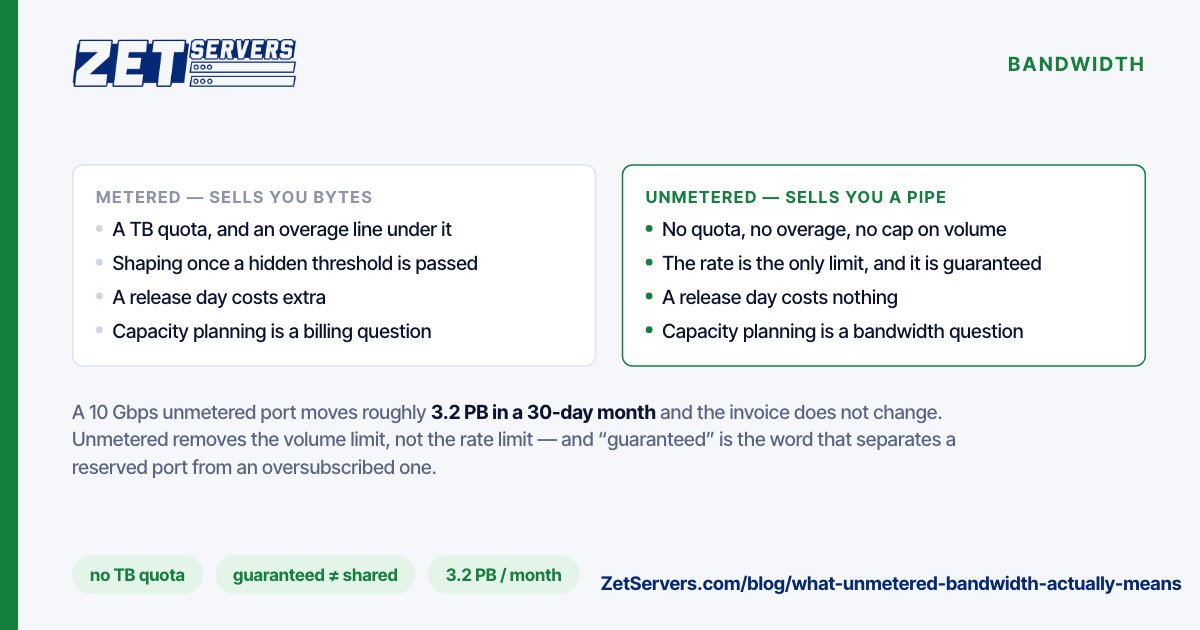
A metered server sells you bytes; an unmetered server sells you a pipe. On a 10 Gbps unmetered port you can move roughly 3.2 PB in a 30-day month and the invoice does not change.
Why the distinction matters
- No traffic cap, no TB quota, no overage line on the invoice.
- Capacity planning becomes a bandwidth question, not a billing question.
- Burst traffic — a release day, a live event — costs nothing extra.
| Port |
Approx. monthly transfer at line rate |
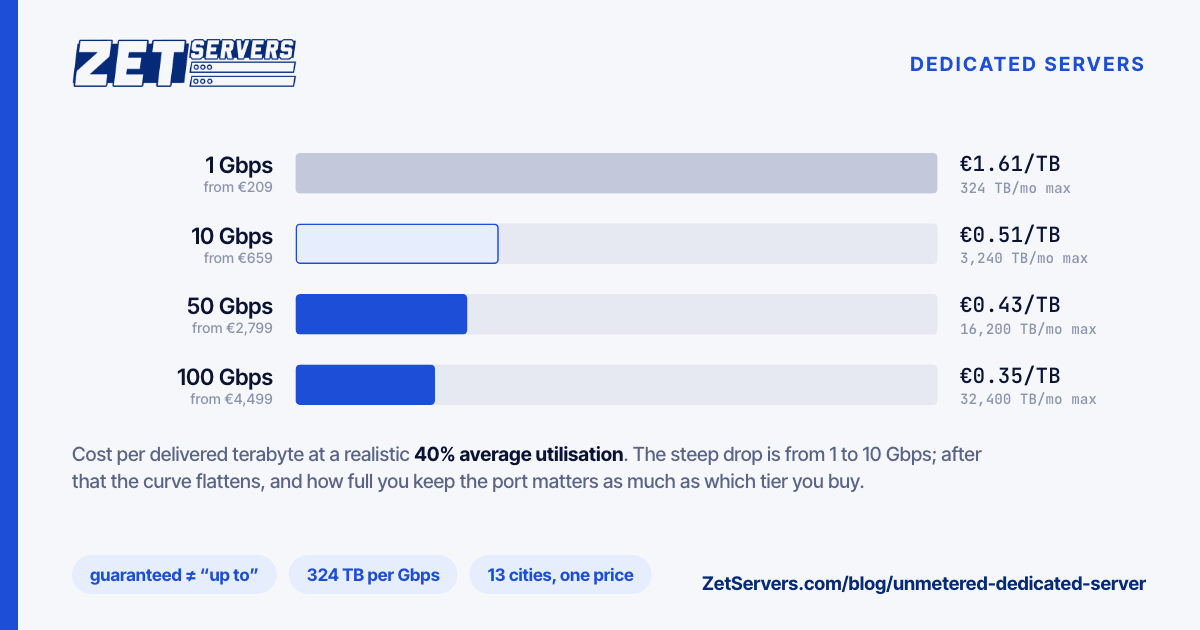
| 1 Gbps |
~320 TB |
| 10 Gbps |
~3.2 PB |
| 100 Gbps |
~32 PB |
What a metered invoice is actually counting
Metered plans come in two shapes, and they behave very differently at the end of the month.
Total transfer is the simple one: every byte in or out is added up against a quota, typically stated in terabytes, and anything past it is billed per unit. Predictable, and punishing on a bad day — one unexpectedly popular release can cost more than the server.
95th percentile is what wholesale transit uses, and it is worth understanding even if you never buy it directly. Your port is sampled every five minutes for the whole month, the samples are sorted, the top 5% are discarded, and you are billed on the highest sample that remains. The discarded slice is roughly 36 hours a month, which is the mechanism's one genuine kindness: short spikes are free. Sustained load is not, and a workload that is busy every evening pays for every evening.
Both models make the same demand of you — that you forecast volume — and both turn a traffic success into a billing event. Paying for the pipe removes the forecast from the equation. The number you have to get right becomes the rate, which you can measure, rather than the total, which you can only guess.
"Unlimited" is a different word
An unlimited metered plan is a plan with a limit somewhere you have not read yet. It usually lives in one of three places:
- A fair-use clause, which sets an unstated threshold and reserves the right to act on it.
- Shaping, where the port is quietly reduced once you pass that threshold — the traffic still flows, just not at the speed you bought.
- A ratio rule, where your allowance is tied to something else, such as the size of your disk or the number of accounts.
None of those exist on a guaranteed unmetered port, because the limit is the port itself and it is stated on the order form. That is the whole trade: you accept a hard ceiling on rate, and in exchange nothing about your volume is anybody's business.
Guaranteed, shared, and "up to"
The word that decides what you actually get is not unmetered, it is guaranteed.
A guaranteed port reserves capacity for your server all the way through the network. A shared or oversubscribed port sells the same capacity to several servers on the assumption they will not all want it at once — which is usually true, and is exactly wrong at peak, when everyone's peak arrives together. The order form for one of these often says "up to" or "burst", and those two phrases are the tell.
Three questions separate them, and any provider can answer all three in a sentence:
- Is the rate guaranteed or best-effort? If the answer needs a paragraph, it is best-effort.
- What is the uplink from the rack, and how many servers share it? A rack of 10 Gbps servers behind a single 10 Gbps uplink is arithmetic, not a network.
- Whose network is it past that? A guaranteed port into congested transit is a guarantee that stops at the building. Peering vs transit covers what happens after the packet leaves the rack, and our own backbone is described on the network page.
Then verify rather than trust. Run mtr from your own network against a host in the location you are considering before you commit to it — latency and loss on the path your users will actually take beat any number in a marketing table. Once the server is yours, measure the port itself with iperf3 in both directions.
When metered is the cheaper answer
Unmetered is not automatically the better deal, and it is worth being honest about where it is not.
If your traffic is genuinely small — a few terabytes a month, flat, with no events — a metered plan priced for that volume will usually cost less, because you are not paying to reserve capacity you never use. The crossover comes from two directions: volume, when the quota starts costing more than the pipe, and variance, when you cannot predict the month and the overage risk is what you are really buying insurance against.
Workloads that reach the crossover early: live streaming and VOD, game and software distribution, backup and replication targets, VPN and proxy egress, and anything with a release cycle. Workloads that rarely do: brochure sites, low-traffic applications, and internal tools.
Frequently asked questions
Is unmetered the same as unlimited?
No. Unmetered removes the volume limit but keeps the rate limit. Your port runs at its guaranteed speed continuously; there is no byte quota on top of it, which is what "unlimited traffic on a guaranteed line" describes.
Does traffic get shaped after some threshold?
Not on a guaranteed unmetered port. Shaping after a hidden threshold is what makes an "unlimited" metered plan unlimited in name only.
Does unmetered count both directions?
On a guaranteed port the rate applies to each direction independently — a 10 Gbps port is 10 Gbps in and 10 Gbps out, not 10 Gbps combined. Egress is what most workloads care about, but a backup target or an ingest server should confirm the inbound side is the same number.
What happens if I saturate the port continuously?
Nothing. Running the line flat out is the product, not an exception, and there is no threshold at which the invoice changes or the port is reduced. The only thing that changes is that you have found your ceiling, which is the signal to move up a tier.
Next steps
Decide the tier from your measured peak rather than your monthly total, then confirm the line delivers it. The dedicated server tiers list every guaranteed port speed from 1 to 200 Gbps, 10 Gbps is where most delivery workloads land, and unmetered VPS plans carry the same guarantee at a smaller scale.