Buying servers for a VPN provider is a fleet problem, not a server problem. One exit node is easy to specify and tells you almost nothing about what the next fifty cost. The numbers that decide a VPN business are subscribers per node, the oversubscription ratio you are willing to run, and how many countries you must appear in — and those three interact in ways that make the cheapest per-node price frequently the wrong buy.
Start with subscribers per node
The chain is short and each link is measurable.
Concurrency. Not every subscriber is connected. Consumer VPN concurrency typically runs 10–25% at peak; business VPN runs far higher because the tunnel is always up. Measure yours; assume 20% only until you have data.
Throughput per active session. This is where estimates go wrong. Average sustained use per connected session is low — often 0.5 to 2 Mbps, because most sessions are idle most of the time. What you must survive is the tail: a small share of sessions streaming or downloading at 20–100 Mbps each.
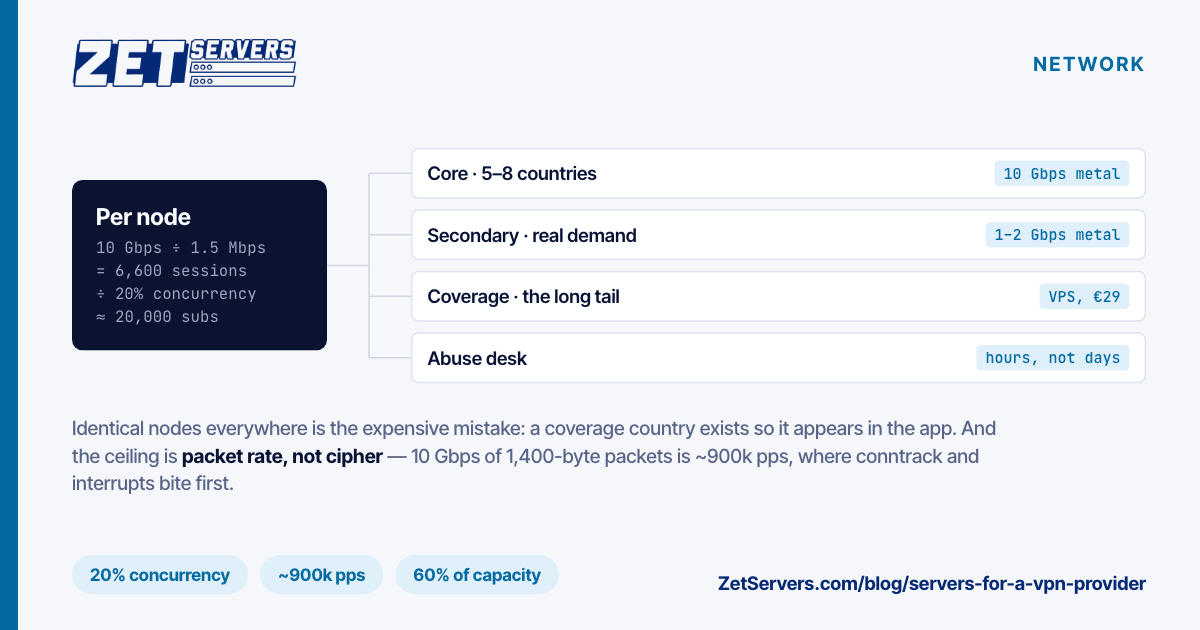
Work an example. A 10 Gbps guaranteed node, 20% concurrency, 1.5 Mbps average per active session:
10,000 Mbps ÷ 1.5 Mbps = 6,600 concurrent sessions
6,600 ÷ 0.20 concurrency = 33,000 subscribers
Then apply headroom. Run at 60% of theoretical capacity and it is closer to 20,000 subscribers per 10 Gbps node. Push past 80% and the tail sessions start colliding, which subscribers experience as "the VPN is slow tonight" — the complaint that drives churn.
At €659 for a 10 Gbps build, 20,000 subscribers is about €0.033 per subscriber per month in server cost. That number is the one to carry into pricing discussions, and it is the reason capacity planning is a margin question rather than an engineering one.
The CPU limit nobody plans for
Bandwidth is not usually what caps an exit node. Encryption and packet forwarding are, and they cap on the wrong axis.
ChaCha20-Poly1305 and AES-GCM both run fast on modern cores with hardware acceleration — several gigabits per core. The problem is that a VPN's load is small packets, not large ones, and per-packet overhead dominates. A node pushing 10 Gbps of 1,400-byte packets handles about 900,000 packets per second, and at that rate interrupt handling, connection tracking and the userspace-kernel boundary matter more than the cipher.
Three practical consequences:
- WireGuard in-kernel beats userspace OpenVPN by a wide margin at the same hardware, because it avoids the boundary crossing per packet.
- Connection tracking is a real limit.
nf_conntrack_max defaults far below what thousands of NAT'd subscribers need, and the table filling up looks like random connection failures. Size it deliberately and watch nf_conntrack_count.
- Interrupt distribution matters. Multi-queue NICs with RSS spreading across cores; without it one core saturates while the rest idle.
VPN exit node hosting covers the MTU and MSS clamping details that cause the other classic support ticket — the tunnel connects, and some sites never load.
IP address strategy is the business risk
A VPN provider's largest operational risk is not capacity. It is that the addresses your subscribers exit from get blocked, and blocklists act on whole ranges rather than single addresses.
Three approaches, in increasing order of control:
- Provider-assigned addresses. Fastest to deploy, cheapest, least control. You inherit whatever reputation the range already has and share fate with other tenants.
- A dedicated range assigned to you. Better isolation. Reputation is yours to build and yours to ruin.
- Your own address space, announced by the host. Full control and portability — the range follows you between providers, so a reputation you built survives a migration. Announcing your own IP space covers the RIR and BGP mechanics.
Whichever you choose, the operational rule is the same: an abuse process that responds in hours, not days. Ranges get delisted when the operator is responsive and stay listed when they are not.
Country coverage sells subscriptions; utilisation pays for them. Those goals fight, and most providers resolve it wrong by buying identical nodes everywhere.
The pattern that works is tiered:
| Tier |
Where |
Build |
| Core |
Your 5–8 highest-demand countries |
Bare metal, 10 Gbps guaranteed |
| Secondary |
Moderate demand |
Bare metal, 1–2 Gbps guaranteed |
| Coverage |
The long tail on your marketing page |
VPS, 1 Gbps guaranteed |
A coverage node at €29 that carries 200 concurrent sessions is doing its job — it exists so the country appears in your app. Buying a €659 machine for that country is a pure loss, and buying a €29 one for a core market is churn.
The other half of footprint is path quality rather than presence. A subscriber in Warsaw exiting in Frankfurt cares about the route between them; a node with a short, stable path outperforms a closer node behind congested transit. That is a network question, not a hardware one, and worth testing with real traffic before you commit a region.
Scaling checklist
- Concurrency ratio, measured on your own subscriber base.
- Average and 95th-percentile throughput per active session.
- Nodes sized to 60% of theoretical capacity, never 100%.
nf_conntrack_max, file descriptors and somaxconn raised before launch, not after.- MTU and MSS clamping verified on mobile networks, where the classic path-MTU failure appears first.
- An abuse address that a human reads, and a documented response time.
- Per-node monitoring on packets per second, not just bits per second.
Frequently asked questions
How many subscribers can one exit node hold?
Roughly 20,000 on a 10 Gbps node at 20% concurrency and 1.5 Mbps average, run at 60% capacity. Every one of those inputs is specific to your subscriber base — re-derive it from your own data rather than adopting the figure.
Bare metal or VPS for exit nodes?
Bare metal for core markets where throughput and packet rate matter. VPS for coverage markets where presence matters more than capacity. Mixing them deliberately is the cost-efficient answer, and the servers for VPN range is built to be mixed.
Does the cipher choice affect how many servers I need?
Less than packet size does. Modern ciphers are fast; per-packet overhead is what caps a node. Optimise the packet path — kernel WireGuard, multi-queue NICs, sane conntrack — before buying more cores.
What happens when an IP range gets blocklisted?
You need a range you control and an abuse process that answers quickly. Providers who respond within hours get delisted; those who do not accumulate blocks until the range is worthless.
How do I plan for growth without overbuying?
Buy core-market capacity at 60% utilisation and add nodes when sustained peak crosses 70%. That leaves a full provisioning cycle of margin — send us your concurrency numbers and we will map the fleet.