Plex server hosting means running Plex Media Server, or Jellyfin as the free alternative, on a rented machine in a data centre instead of a box at home. The reason is rarely the CPU. A home connection uploads a fraction of what it downloads, and every remote stream leaves through that upload. One rule first: the server is for media you have the rights to.
Upload is the bottleneck, and a data-centre port is not
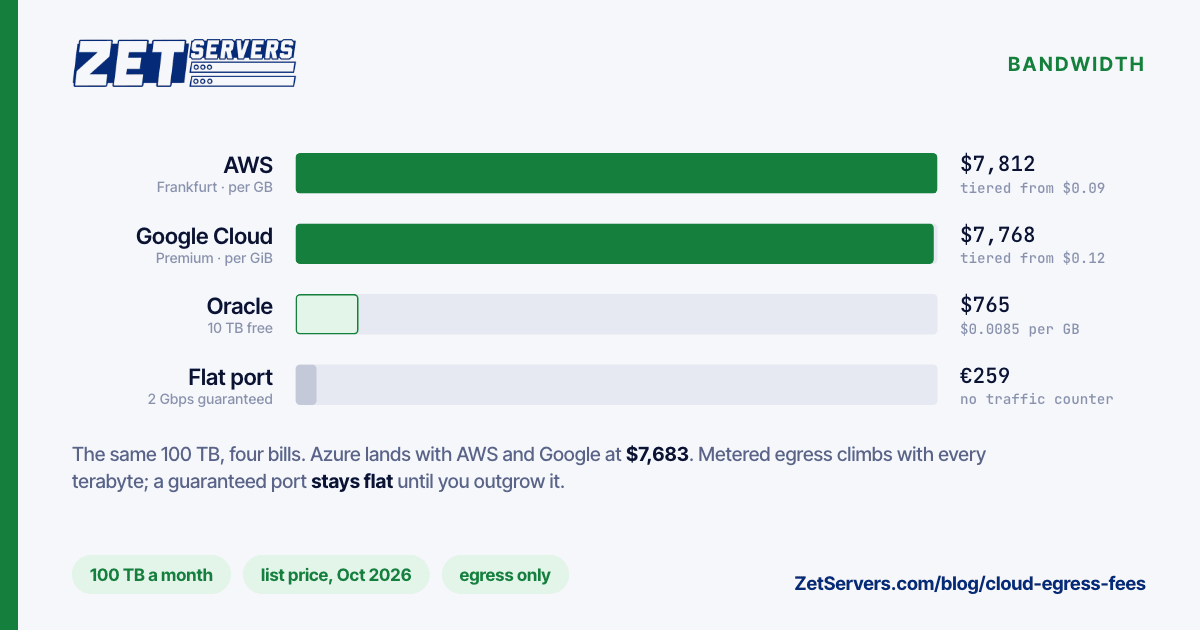
Every remote viewer pulls their stream out of the server's upload. Plex's CPU guidance says remote access very often needs transcoding because the network often cannot carry full quality.
Take a home line with 20 Mbps of upload. Two 1080p streams at 10 Mbps, the bitrate Plex uses for its 1080p reference file, fill it. A 40 Mbps 4K file cannot leave the house without a transcode.
A data-centre port divides the same way, by a much larger number. Streams = port speed ÷ bitrate:
| Stream |
Bitrate |
1 Gbps port |
2 Gbps port |
| 720p H.264 |
4 Mbps |
250 |
500 |
| 1080p H.264 |
10 Mbps |
100 |
200 |
| 4K SDR HEVC |
40 Mbps |
25 |
50 |
| 4K HDR HEVC |
50 Mbps |
20 |
40 |
Keep about 20% back for overhead and peaks, and 1 Gbps still carries 80 direct-played 1080p streams or 16 in 4K HDR. Our guarantee applies per direction, so uploads into the library never compete with outgoing streams. Platform-scale sizing is in concurrent viewers per server.
Design for direct play
Plex plays each file in one of three ways. Direct play sends the file as it is. Direct stream repackages the container or converts the audio and leaves the video alone. Transcode decodes and re-encodes the video in real time, per viewer.
Plex's minimum for no transcoding is an Intel Atom at 1.2 GHz, and two simultaneous transcodes need roughly twice the CPU of one. Direct play costs almost nothing per viewer, so the port becomes the limit instead of the processor. Three habits get most libraries there:
- Store codecs your viewers' apps play natively. Check each app first.
- Prefer text subtitles. Plex notes that many apps can only show subtitles by burning them into the picture, which forces a transcode.
- Set each client's remote quality to original or maximum, or it asks for a transcode the port never needed.
Size the CPU for the transcodes left over
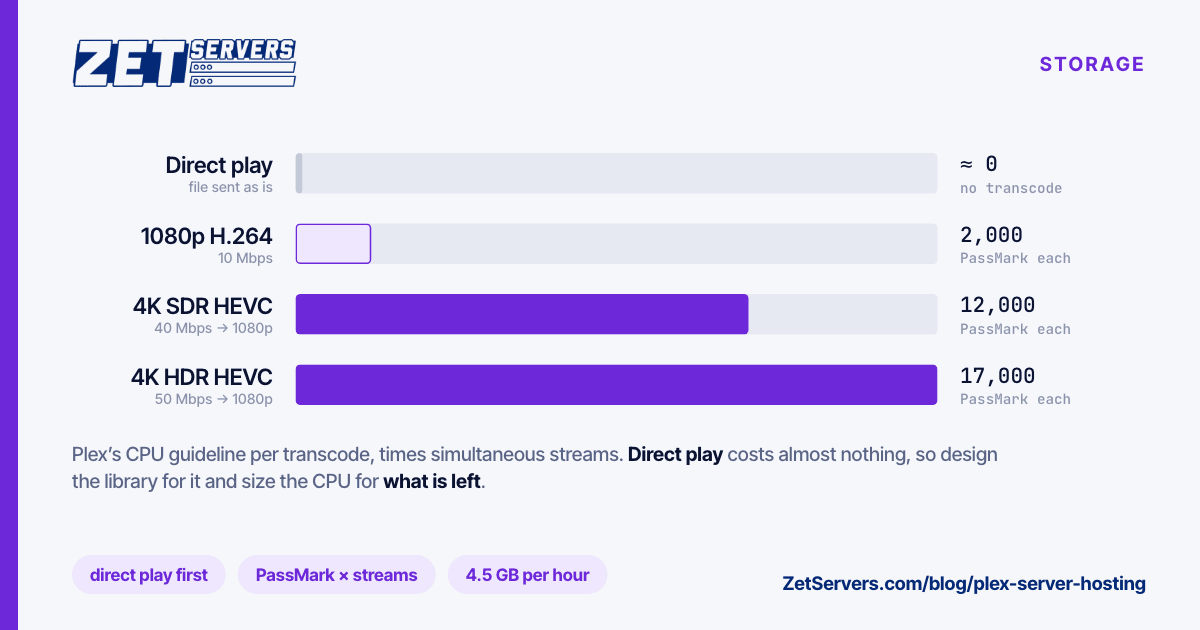
Some transcodes happen anyway. Plex's PassMark guideline for one full transcode of an average source file:
| Source file |
PassMark per transcode |
| 4K HDR, 50 Mbps, 10-bit HEVC, to 1080p |
17,000 |
| 4K SDR, 40 Mbps, 8-bit HEVC, to 1080p |
12,000 |
| 1080p, 10 Mbps, H.264 |
2,000 |
| 720p, 4 Mbps, H.264 |
1,500 |
Multiply by simultaneous transcodes. Plex's own example: four 1080p transcodes need 4 × 2,000 = 8,000. Two 1080p plus one 4K HDR need 2 × 2,000 + 17,000 = 21,000. Three 4K HDR need 51,000, and Plex says that for several 10-bit HEVC files at once, a fast enough processor may not exist. Then look up your CPU's score. Plex calls this a rough guide, not a measurement; single-thread speed matters too.
Hardware transcoding needs a GPU, and on Plex a pass
Hardware-accelerated streaming moves the work onto a video engine: Intel Quick Sync, or an NVIDIA GPU with driver 450.66 or newer. Plex's hardware acceleration page adds two conditions: the server owner needs an active Plex Pass, and it is not currently possible inside a virtual machine, so a Plex VPS transcodes on the CPU only.
The Xeon E5 and EPYC builds on our pages have no integrated GPU, so no Quick Sync. Plan for direct play or CPU transcoding; GPUs are available only as a custom configuration, on request. To see what a machine has:
lspci -nn | grep -Ei "3d|display|vga"
Jellyfin's hardware acceleration is free. On Linux its documentation supports Intel QSV, NVIDIA NVENC and VA-API for AMD. One trap applies to both servers: no Intel, NVIDIA or AMD GPU hardware-decodes 10-bit H.264, so those files fall back to the CPU.
Plex is free on your local network. A data-centre server shares none with your television, so every playback is remote and needs one of these:
- A Plex Pass on the server's admin account. Everyone you share with can stream remotely, and hardware transcoding becomes available.
- A Remote Watch Pass on the viewer's own account. It covers that account and its Plex Home managed accounts, with no other Plex Pass features.
Plex's plans page, checked in October 2026, lists the Remote Watch Pass at €2.99 a month or €27.99 a year, and Plex Pass at €5.99 a month or €59.99 a year, plus five-year and lifetime terms. Three viewers on annual Remote Watch Passes pay 3 × €27.99 = €83.97 between them, against €59.99 for one annual Plex Pass. Jellyfin has no subscription at all; you set up remote access and HTTPS yourself.
Storage: hours per terabyte
A file's size is bitrate times length. Multiply Mbps by 60 × 60 seconds, divide by 8 bits per byte and 1,000 MB per GB: gigabytes per hour = Mbps × 0.45.
| Source |
Bitrate |
GB per hour |
Hours in 72 TB |
| 1080p H.264 encode |
10 Mbps |
4.5 |
16,000 |
| 4K SDR HEVC |
40 Mbps |
18 |
4,000 |
| 4K HDR HEVC |
50 Mbps |
22.5 |
3,200 |
Our storage node's eight 12 TB drives in RAIDZ2 give about 72 TB usable, per the product page. At two hours a film, that is 8,000 films in 1080p or 1,600 in 4K HDR. For remuxes, plug in the file's real bitrate. Tools that report binary units show 72 TB as about 65.5 TiB, before filesystem overhead. Why double parity suits drives this size is covered in choosing a RAID level.
Put the database on the SSD
Hard drives handle large sequential media reads well; the library database, artwork and transcoder scratch files are small random IO, which they do not. Our storage nodes have a separate 240 GB SSD for the OS and metadata, and Jellyfin's documentation recommends an SSD or RAM disk for transcoded segments. On Plex, keep the data directory and the transcoder temporary directory (Settings > Server > Transcoder) on the SSD, and watch its size:
du -sh "/var/lib/plexmediaserver/Library/Application Support/Plex Media Server"
Our servers, for reference
Our storage servers pair dual Xeon E5-2660v3 (20 cores, 40 threads) and 128 GB of DDR4 with eight 12 TB SATA drives and a 240 GB SSD. Prices checked October 2026: €549 a month with 2 Gbps guaranteed, €789 with 5 Gbps and €1,189 with 10 Gbps, in Bucharest or Frankfurt, built in about a week. The seedbox page lists Plex and Jellyfin among supported stacks; seedbox vs dedicated server weighs a shared slot against a whole machine.
For a smaller library, 1 Gbps dedicated servers start at €209 a month for dual Xeon E5-2630v4, and a single EPYC 9254 is €449. None has an integrated GPU.
Frequently asked questions
Do I need Plex Pass for Plex server hosting in a data centre?
For remote video, yes, or a Remote Watch Pass. A data-centre server shares no local network with your devices, so every stream is remote. A Plex Pass on the admin account covers everyone you share with and enables hardware transcoding; a Remote Watch Pass covers only its own account.
Can I run Plex on a VPS?
Yes, with one limit. Direct play and CPU transcoding work normally, but Plex states that hardware-accelerated streaming is not currently possible inside virtual machines, because the hypervisor does not expose the video hardware to the guest. Size the vCPUs with Plex's PassMark guideline, or prepare the library so files play directly.
How many Plex streams can a 1 Gbps server handle?
At Plex's reference bitrates, a 1 Gbps port carries 100 direct-played 1080p streams at 10 Mbps, or 20 in 4K HDR at 50 Mbps. Keeping about 20% back for overhead and peaks leaves 80 and 16. Transcoded streams run out of CPU long before they run out of port.
Is Jellyfin a good alternative to Plex on a rented server?
For many people, yes. Jellyfin is free, has no remote-streaming subscription, and supports hardware acceleration through Intel QSV, NVIDIA NVENC and, for AMD on Linux, VA-API at no cost. The trade-off is that you set up remote access and HTTPS yourself, and still need a supported GPU to transcode in hardware.
How much storage does a Plex library need?
Multiply bitrate by running time: Mbps × 0.45 gives gigabytes per hour. A 1080p encode at 10 Mbps uses 4.5 GB an hour; a 4K HDR file at 50 Mbps, 22.5 GB. A 96 TB node in RAIDZ2, about 72 TB usable, holds roughly 16,000 hours of the first or 3,200 of the second.