An unmetered dedicated server is a whole physical machine whose monthly price covers a network port rather than a quantity of traffic. You pay for the size of the pipe; what flows through it does not appear on the invoice. That one sentence hides most of the difference between a good offer and a bad one, because "unmetered" says nothing about whether the pipe is actually yours at the busy hour. This guide covers what to check in the contract, how to choose a bandwidth tier, what each tier really costs per terabyte, and where you can put the machine.
Unmetered, unlimited and guaranteed are three different promises
Hosting pages use these words loosely, so pin them down before comparing prices:
- Metered — you buy a traffic allowance (say 20 TB) and pay per terabyte beyond it, or get throttled.
- 95th percentile — the provider samples your rate every five minutes, discards the top 5% and bills the rest. Common for wholesale transit; 95th percentile billing walks through the arithmetic.
- Unmetered — no count of bytes at all. The port speed is the only limit.
- Guaranteed — the port speed is reserved for you end to end, not shared with neighbours on an oversold uplink.
The trap is "unmetered" without "guaranteed". A 1 Gbps port on a switch whose uplink is shared twenty ways is unmetered, and it may deliver 150 Mbps at 21:00. What unmetered bandwidth actually means covers how that oversubscription works and how to spot it.
Five clauses to read before you order
The plan page sells the port. The terms decide whether you keep it. Ask for these in writing:
- Is the rate guaranteed or "up to"? "Up to 10 Gbps" is a ceiling. You want a floor.
- Is there a fair-use clause? Many "unlimited" offers carry a sentence letting the provider throttle "excessive" use. If it exists, ask what the number is.
- Is it symmetric? Some offers guarantee inbound but cap outbound, which is the direction a delivery server actually uses.
- What happens at a sustained 100%? A good answer is "nothing". Any other answer is a metered plan with extra steps.
- Can the port grow in place? Moving to a bigger tier should be a configuration change, not a migration to a new box.
Here is how our own dedicated plans answer them. The listed rate is guaranteed in each direction, and using all of it around the clock carries no cap and no overage charge. Short bursts above the guaranteed rate are allowed; if a server runs above it repeatedly, our terms say we will contact you about moving up a tier — refusing can end in suspension, but past overuse is never billed. And the port can be raised to a higher tier on the same machine rather than by migrating to a new one.
Choosing a tier
Start from the traffic, not the hardware. One gigabit per second held flat out for 30 days moves:
1 Gbps = 125 MB/s × 86,400 s × 30 days ≈ 324 TB a month
No real service runs flat out, so divide by your utilisation. A download or video origin averaging 40% of its port uses about 130 TB a month per gigabit; a busy evening-peak service might average 25%. Work out your peak rate, size the port for that, and the monthly total takes care of itself. Choosing an uplink speed has worked examples for streaming, file hosting and VPN pools.
Rough starting points:
- 1–2 Gbps — a VPN exit, a web application with large assets, a first streaming origin, a backup target.
- 5–10 Gbps — a VOD library, a CDN origin feeding several pull zones, a busy download mirror.
- 20–50 Gbps — national-scale streaming, large VPN pools concentrated on a few machines, software distribution.
- 100–200 Gbps — live events and aggregation, where one box has to absorb the peak of a large audience.
What each tier costs per terabyte
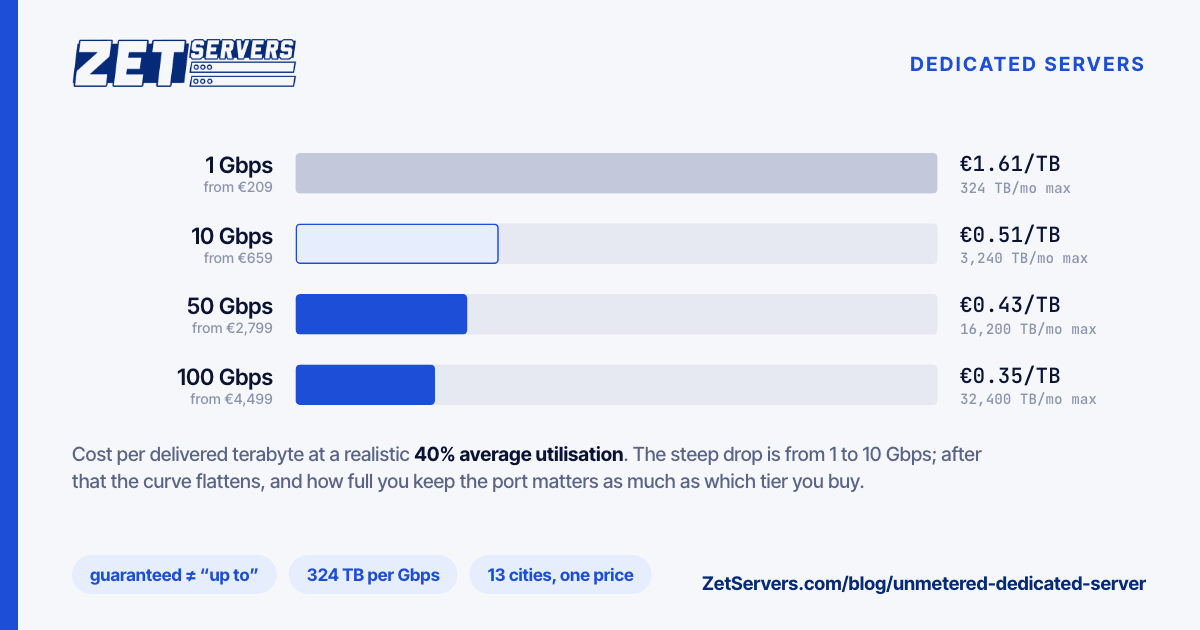
Unmetered pricing only makes sense against what the same traffic would cost metered. Here is the entry price of each ZetServers tier, with the cost of a delivered terabyte at full use and at a realistic 40%:
| Tier |
From |
TB/month at 100% |
€/TB at 100% |
€/TB at 40% |
| 1 Gbps |
€209 |
324 |
€0.65 |
€1.61 |
| 2 Gbps |
€259 |
648 |
€0.40 |
€1.00 |
| 5 Gbps |
€519 |
1,620 |
€0.32 |
€0.80 |
| 10 Gbps |
€659 |
3,240 |
€0.20 |
€0.51 |
| 20 Gbps |
€1,159 |
6,480 |
€0.18 |
€0.45 |
| 50 Gbps |
€2,799 |
16,200 |
€0.17 |
€0.43 |
| 100 Gbps |
€4,499 |
32,400 |
€0.14 |
€0.35 |
Two things stand out. The price per terabyte falls steeply up to 10 Gbps and then flattens, so the jump from 1 to 10 Gbps is the one that changes the economics. And utilisation matters as much as the tier: a 10 Gbps port you fill to 40% costs less per terabyte than a 1 Gbps port you fill completely. The cost per terabyte of bandwidth shows how to run the same sum on any quote.
The "from" prices use the entry configuration of each tier — a dual Xeon E5-2630 v4 up to 20 Gbps, a dual Xeon Gold 6148 from 25 to 100 Gbps — and the hardware rises from there, to dual EPYC at the top. Bandwidth and hardware are chosen separately, so a modest CPU on a large port is a valid order if the workload is delivery.
Where the server can live: 13 cities, one price
Our unmetered dedicated servers are available in 13 cities:
| Region |
Cities |
| Central Europe |
Frankfurt, Amsterdam, Vienna, Warsaw |
| Western Europe |
Paris, Dublin |
| Southern Europe |
Madrid, Lisbon, Milan, Marseille |
| South-east Europe |
Bucharest, Sofia |
| North America |
Ashburn |
The location does not change the price. In our order system the city is a free option on every dedicated plan, so a 10 Gbps server costs the same in Lisbon as in Frankfurt. What differs between cities is stock — a particular configuration may be ready in one city and built to order in another — and who the city is close to.
That second point is where the choice should be made. Each city sits nearest a different set of users and networks:
- Frankfurt and Amsterdam are the interconnection centre of Europe and the default for audiences spread across the continent.
- Bucharest, Sofia and Warsaw sit closest to eastern Europe, the Balkans, Ukraine and the Baltics.
- Marseille is where subsea cables from Africa, the Middle East and Asia come ashore.
- Madrid and Lisbon cover Iberia; Milan and Vienna cover Italy and the Alpine and Danube regions.
- Ashburn serves North America from the east coast.
Six of these cities have their own guide — Frankfurt, Amsterdam, Bucharest, Marseille, Warsaw and Ashburn — each working through who the city serves, what the latency floor looks like from there, and which workloads suit it.
When unmetered is the wrong choice
It is not always the cheaper option. If your server moves 3 TB a month — a typical business website, an internal tool, a small database — a metered plan with a 20 TB allowance is cheaper and you will never touch the limit. Unmetered pays off when traffic is heavy, steady or unpredictable: delivery, streaming, VPN, mirrors, backup targets, anything where a bill that scales with success is a problem.
Frequently asked questions
Is an unmetered dedicated server really unlimited?
The traffic volume is unlimited; the rate is not. You can transfer as much as the port carries, which at 1 Gbps is about 324 TB in a 30-day month. Beyond that the limit is physics, not a bill.
What is the difference between unmetered and guaranteed bandwidth?
Unmetered means traffic is not counted. Guaranteed means the port rate is reserved for you rather than shared. You want both: an unmetered port on an oversold uplink can still be slow at the busiest hour.
Can I upgrade the bandwidth later?
Yes. Bandwidth is chosen separately from the hardware, so moving up a tier is a change to the port, not a migration. The very top tiers need a matching network card, so mention 100 Gbps plans when you order. Plan for the peak you expect within a year and grow from there.
Does the server location change the price?
No. The city is a free option on our dedicated plans, so the same configuration costs the same in all 13 locations. Availability differs: some builds are in stock in one city and assembled to order in another.
How fast is a new server online?
Most in-stock configurations are active within an hour of confirmed payment, and an operating system install takes 15 to 20 minutes after that. Rarer builds can take two to four weeks; ask on live chat before ordering.