Minecraft server hosting comes down to one fact about how the game works: a Java Edition server runs its world on one main thread, which must finish every tick within 50 milliseconds to hold 20 ticks per second. More cores do not make that thread faster. Clock speed, memory and fast storage do, until the community grows large enough to split across several servers — and then the answer changes from a VPS to a dedicated machine. This guide covers what the server actually uses, how to size it, and where the line between VPS and dedicated falls.
What a Minecraft server actually uses
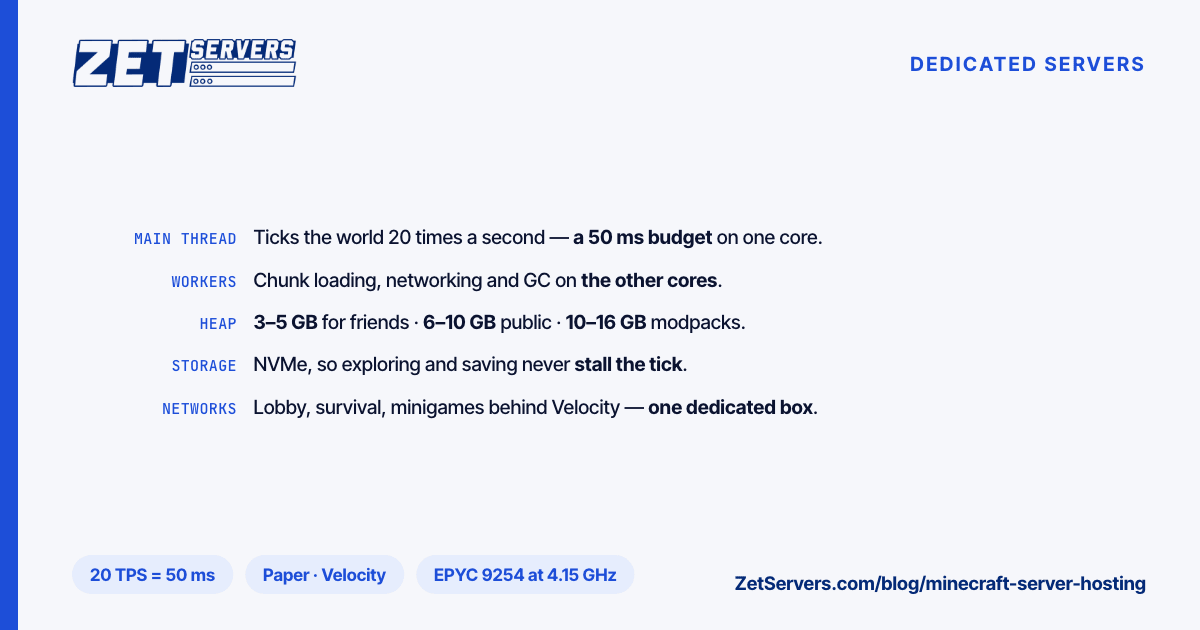
One fast core for the tick. Entities, redstone, block updates, crop growth and mob AI all run on the main thread. When a tick takes longer than 50 ms, the next one starts late, and players see rubber-banding and delayed block breaks. Game server hardware explains why per-core speed decides this, for Minecraft and other tick-based games.
Other cores for everything around it. Modern server software moves chunk loading, chunk generation, networking and garbage collection onto worker threads. Those need cores too, just not as urgently as the main thread. Four cores is a comfortable floor for a busy server.
Memory for loaded chunks, entities and plugins. The Java heap holds the loaded world. Too little and the garbage collector runs constantly; too much, badly tuned, and it pauses for long stretches.
Fast storage for the world. Region files are read when players explore and written on every save. NVMe keeps chunk loading and world saves from stalling the server, and it makes backups of a large world quick.
Java or Bedrock
Java Edition is the PC version with the large plugin and mod ecosystem. It runs on TCP port 25565.
Bedrock Edition runs on consoles, phones and Windows. Mojang publishes the Bedrock Dedicated Server for it, which listens on UDP port 19132 and has a much smaller add-on ecosystem.
Most communities run Java and add the Geyser plugin so Bedrock players can join the same world.
Choosing the server software
- Paper — a high-performance fork of the vanilla server that supports plugins. The default choice for most survival and community servers.
- Purpur — Paper with extra configuration options.
- Fabric — a lightweight mod loader, popular for performance mods and technical play.
- Forge and NeoForge — the loaders behind most large modpacks. Heavy packs need much more memory than plugin servers.
- Velocity — a proxy that links several servers into one network, so players can move between a lobby, survival and minigames.
- Folia — a Paper fork that runs separate regions of the world on separate threads. It suits very large player counts, but many plugins do not support it.
How much server you need
Player count is a rough proxy. What players do matters more: ten players exploring new terrain load the server far more than forty players in a built-up spawn area. Players per game server covers why concurrency estimates need care. Treat these as starting points and measure:
| Setup |
Starting point |
Java heap |
Plan |
| Vanilla or Paper, a few friends |
up to ~10 players |
3–5 GB |
2 vCPU, 8 GB VPS — €59 |
| Paper with plugins, public server |
10–40 players |
6–10 GB |
4 vCPU, 16 GB VPS — €119 |
| Large Forge or NeoForge modpack |
5–30 players |
10–16 GB |
8 vCPU, 32 GB VPS — €239 |
| Velocity network, several backends |
50–200+ players |
per backend |
Dedicated EPYC 9254, 128 GB — €449 |
The smallest €29 plan, with 4 GB of RAM, works for two or three players on a small vanilla world and little else. Leave 1.5–2 GB of RAM outside the heap for the operating system and the JVM's own off-heap memory.
Three settings that matter more than hardware
Simulation distance and view distance. In server.properties, simulation-distance sets how far from each player the world is actively ticked, and view-distance how far it is sent to their screen. Both default to 10 chunks. Lowering simulation distance to 6 or 8 cuts main-thread work sharply, while a higher view distance keeps the scenery.
Pre-generate the world. Generating new chunks is one of the most expensive things the server does. Set a world border and pre-generate everything inside it with a plugin such as Chunky before opening the server, and exploration stops causing lag spikes.
Give the JVM sensible flags. Set the minimum and maximum heap to the same value and use the G1 garbage collector with tuned settings. Paper's documentation publishes a well-tested set, widely known as Aikar's flags:
java -Xms10G -Xmx10G -XX:+UseG1GC -XX:+ParallelRefProcEnabled \
     -XX:MaxGCPauseMillis=200 -XX:+DisableExplicitGC -XX:+AlwaysPreTouch \
     ... -jar paper.jar --nogui
Then measure. The spark profiler plugin shows ticks per second and, more usefully, milliseconds per tick (MSPT). Keep MSPT well under 50 at your busiest hour; a server averaging 45 has no headroom left.
VPS or dedicated server
A VPS suits a single server, from a group of friends to a busy modded world. What matters is that its cores are dedicated: a tick that waits for a neighbour's process on a shared core arrives late, and players notice. Our unmetered VPS plans run on dedicated 3.2 GHz cores with NVMe in RAID 10. They are full KVM machines, so Docker-based tools and game panels install normally — KVM VPS vs container VPS explains why that matters.
A dedicated server suits a network or a hosting business. Once you run a proxy, a lobby, a survival world and a few minigame servers, you are running several Java processes, each wanting its own fast core and several gigabytes of heap. One machine with plenty of both is simpler and cheaper than five VPS. The same applies if you host servers for others with a panel such as Pterodactyl.
Choose the CPU for clock speed. For Minecraft, the single AMD EPYC 9254 is the strongest choice in our range: it boosts to 4.15 GHz on a modern core, against 3.1 to 3.6 GHz on the older Xeon E5 builds. The dual Xeons, with 40 to 88 threads, suit hosting many small servers where no single world is busy. EPYC vs Xeon compares the two families in detail.
Location and network
Players feel latency in every block they break and every hit they land. Put the server in the city nearest the bulk of your players; for a mainly European community, a central location such as Frankfurt or Amsterdam keeps most players within a short round trip.
Bandwidth is rarely the limit for the game itself, but it matters for everything around it: players downloading resource packs, a live web map such as BlueMap or Dynmap, and off-site backups of a world that grows every week. On an unmetered port, none of that shows up on an invoice.
Ask any host exactly what DDoS filtering is included, up to what attack size, and whether it is on by default. Public Minecraft servers attract attacks, and the answer matters more than most specifications. Our game server hosting page covers the options for game communities.
Frequently asked questions
How much RAM does a Minecraft server need?
For a small Paper server, 4–6 GB of heap. Public servers with plugins usually need 6–10 GB, and large modpacks 10–16 GB or more. Leave another 1.5–2 GB outside the heap for the system.
Is a VPS good enough for a Minecraft server?
Yes, for a single server up to a few dozen players or a modded world, as long as the vCPUs are dedicated and the storage is NVMe. Networks of several servers are better on a dedicated machine.
Does Minecraft use multiple cores?
Partly. The main game tick runs on one thread, so single-core speed limits how much the world can do. Paper and other forks move chunk loading, networking and garbage collection onto other cores.
How many players can a Minecraft server handle?
It depends more on what players do than on how many there are. A well-tuned Paper server on a fast core handles dozens; beyond that, split the community across several servers behind a Velocity proxy.
Which CPU is best for Minecraft server hosting?
The one with the highest single-thread performance you can afford. In our range that is the AMD EPYC 9254, which boosts to 4.15 GHz on a modern core.