Every hosting decision eventually comes down to dedicated server vs VPS, and the honest answer is that the two are not competitors for most of their range. A virtual machine is a slice of a physical box with a hypervisor between you and the hardware. A dedicated server is the box. The interesting question is not which is "better" — it is where the slice stops being enough, because that boundary is measurable and you can find it in an afternoon rather than guessing at it for a year.
What the hypervisor actually costs you
On a KVM platform with dedicated cores, the CPU overhead of virtualisation is small — single-digit percent for most workloads, and close to zero for anything that spends its time in userspace doing arithmetic. That is not where VMs lose.
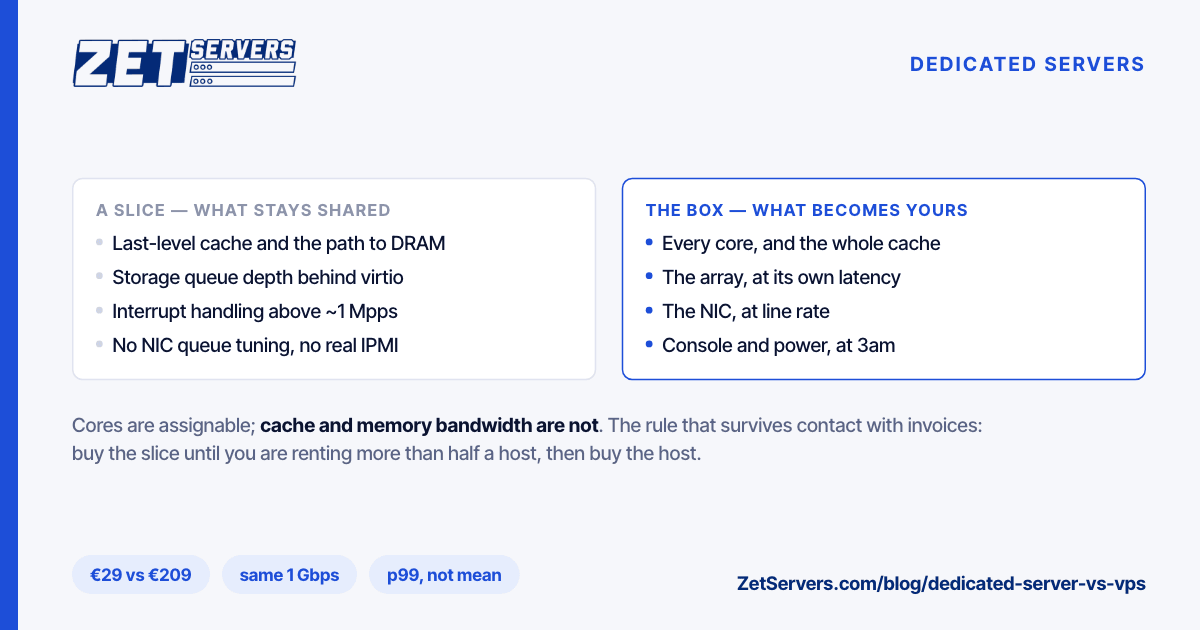
They lose on the things a hypervisor has to share even when the cores are pinned:
- Memory bandwidth and last-level cache. Cores are assignable. The L3 slice and the path to DRAM are not. A neighbour streaming a large working set through cache will slow your process down without ever showing up as steal time.
- Storage queue depth. Your NVMe pool is real hardware behind a virtio queue shared with other guests. Sequential throughput usually survives; the tail latency on random reads is what moves.
- Interrupt handling at high packet rates. Above roughly a million packets per second, the difference between a virtio NIC and an SR-IOV or bare-metal NIC stops being academic.
- Kernel-level control. Custom kernels load fine under KVM. What does not exist is direct access to a NIC's queue configuration, hardware offload tuning below the driver, or a real IPMI console.
None of that matters for a web application, a queue worker, a control-plane node or a build agent. All of it matters for a transcoder, a storage array, a packet-forwarding box or a database whose working set outgrew the cache.
Four ceilings, in the order people hit them
Single-thread performance. A game loop, a Node process, an interpreted request handler and a single-writer database all run in one thread with a deadline. Slicing a box into more vCPU cores never makes that thread faster. If your bottleneck is one core at 100% while fifteen others idle, more instances will not save you and neither will a bigger VPS.
Disk. Watch await and the read latency percentiles, not the throughput number. A VPS that averages 0.4 ms and spikes to 40 ms under a neighbour's backup window is a VPS you have outgrown, even though the average looks fine.
Network. A port speed is a ceiling, a guaranteed rate is a floor, and the gap between them is where most surprises live. Our unmetered VPS plans sit on a 25 Gbps port with 1 to 8 Gbps guaranteed by plan; a bare-metal build is sold by the guaranteed rate directly, from 1 Gbps up to 200. If you cannot say which of those two numbers your traffic is actually testing, verify the port speed before you spend anything.
Memory. RAM is the one resource a hypervisor cannot fake. When the working set no longer fits, everything else stops mattering.
Where the money lands
Compare like for like — guaranteed rate against guaranteed rate:
| Build |
Guaranteed |
Price |
| VPS, 1 vCPU / 4 GB / 50 GB NVMe |
1 Gbps |
€29/mo |
| VPS, 16 vCPU / 64 GB / 800 GB NVMe |
8 Gbps |
€459/mo |
| Bare metal, dual Xeon E5-2630v3 / 128 GB |
1 Gbps |
€209/mo |
| Bare metal, dual Xeon E5-2630v3 / 128 GB |
10 Gbps |
€659/mo |
The entry VPS is seven times cheaper than the entry dedicated box at the same guaranteed rate, and it should be — it is a fraction of a machine. The comparison flips when you need the whole thing: 128 GB of RAM and 16 real cores cost far more as a virtual machine than as a physical one, because at that size you are renting most of a host anyway and paying for the abstraction on top.
The rule that survives contact with invoices: buy the VPS until you are renting more than half a host, then buy the host.
The test that settles it in an afternoon
Do not reason about this. Measure it.
- Take your production workload's busiest hour and replay it against the current VPS. Record p50 and p99 latency, not the mean.
- Pin the bottleneck.
pidstat -t for a saturated thread, iostat -x 1 for await and queue depth, sar -n DEV 1 for packets per second, vmstat 1 for steal and swap.
- Rent one bare-metal box for a month and replay the same hour.
- Compare p99. If it does not move, your bottleneck was your code and a bigger machine was never the fix.
That last step is the one people skip, and it is the one that saves the most money. Half the migrations we see fix a query plan, not a hardware limit.
When a VPS stays the right answer
- Anything that scales horizontally and is happier as six small boxes than one large one.
- Workloads whose peak is short and whose average is low — you are buying elasticity, not iron.
- Edge and relay roles: a restreaming node or a VPN reception point pushes bytes without needing local disk or cores.
- Anything where an hour of downtime during a hardware failure is unacceptable and you would rather re-launch an instance than wait for a hands-on repair.
And when it stays the wrong one: transcoding ladders, storage arrays, database primaries with large working sets, packet-forwarding at multi-gigabit rates, and any workload where you need to read a hardware sensor or reinstall over IPMI at three in the morning.
Frequently asked questions
Is a dedicated server always faster than a VPS?
No. A modern VPS on a fast host will beat an old dedicated box on nearly every axis. The comparison that matters is between the specific machines you can actually buy this month, at the same price point, running your workload.
Does dedicated server vs VPS change how bandwidth is billed here?
No. Both are sold unmetered — a guaranteed rate with no traffic cap and no overage. What changes is the size of the guarantee: 1 to 8 Gbps on the VPS range, 1 to 200 Gbps on bare metal. The unmetered dedicated server buyer's guide covers what to check in either contract.
How long does a bare-metal build take to deliver?
In-stock configurations come online within the hour. Custom builds — unusual disk counts, specific CPU models, large memory — run to about a week. A VPS is up in about a minute.
Can I move from one to the other without downtime?
Close to it, with planning: build the new machine, sync data twice, cut DNS with a short TTL, keep the old box running for a day as a rollback. Databases need replication rather than a file copy.
What if I need more than one dedicated server?
Then the next question is whether you should be renting at all. Past roughly a rack of hardware, colocation starts winning on three-year cost — and if you are near that line, talk to us before you sign anything.