An Ashburn dedicated server is how a European service reaches North America without leaving its provider. Ashburn, in Loudoun County, Virginia, is widely described as the largest data-centre market in the world, and it sits within a few milliseconds of Washington and New York and within about 15 ms of floor of Chicago, Toronto and Atlanta. For a business whose primary is in Europe and whose American audience is growing, it is the one US location that makes sense first. This guide covers who Ashburn reaches, how it pairs with a European primary, and what long-distance links change about running a server.
Why Ashburn
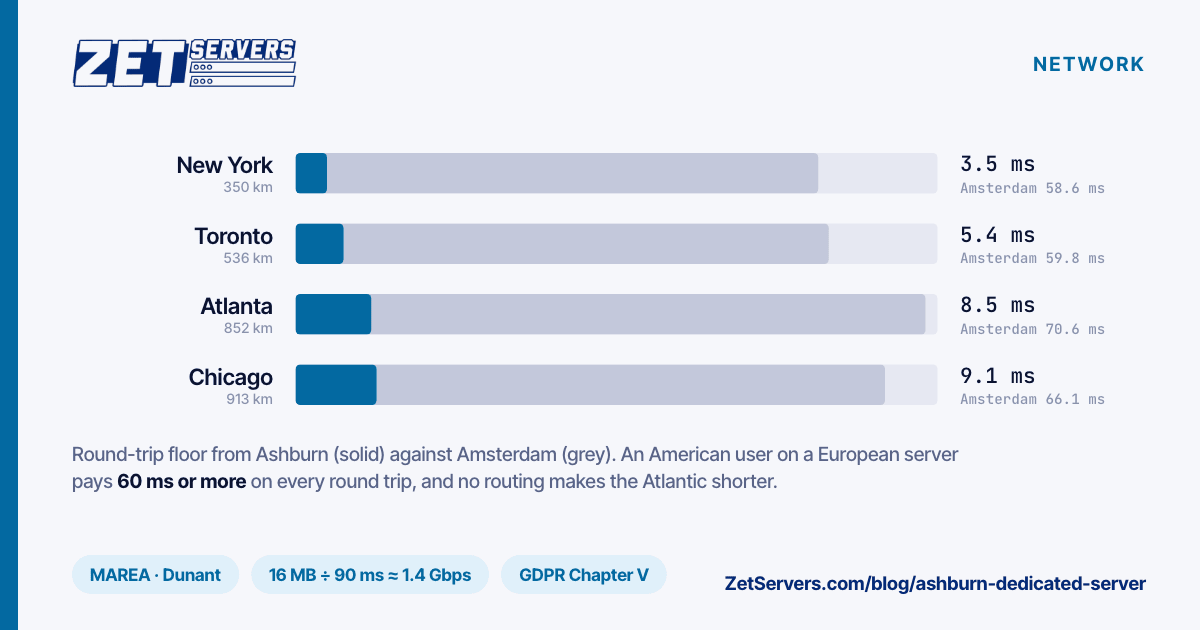
The US east coast is where transatlantic traffic lands. Cables such as MAREA, from Bilbao, and Dunant, from the French Atlantic coast, come ashore at Virginia Beach, a few hundred kilometres from Ashburn, and the region has grown into the densest concentration of data centres, carriers and cloud networks anywhere. A server in Ashburn is close to that interconnection and close to a large share of the North American population.
For a European company, it has a second advantage: it is the shortest transatlantic hop from Europe's hubs to a major US interconnection point, so a primary in Amsterdam or Frankfurt and a standby or edge in Ashburn are as close together as two continents allow.
Who an Ashburn server is close to
The method used throughout this series still applies — straight-line distance divided by 100 for the round-trip floor, then 30 to 50% more for real cable routes and a little router delay:
| From Ashburn to |
Great-circle |
Theoretical floor |
Working estimate |
| New York |
350 km |
3.5 ms |
6–7 ms |
| Toronto |
536 km |
5.4 ms |
8–10 ms |
| Atlanta |
852 km |
8.5 ms |
12–15 ms |
| Chicago |
913 km |
9.1 ms |
13–16 ms |
| Miami |
1,498 km |
15.0 ms |
20–24 ms |
| Dallas |
1,868 km |
18.7 ms |
25–30 ms |
| Los Angeles |
3,652 km |
36.5 ms |
48–57 ms |
| Dublin |
5,462 km |
54.6 ms |
72–84 ms |
| London |
5,917 km |
59.2 ms |
78–91 ms |
| Amsterdam |
6,208 km |
62.1 ms |
82–95 ms |
| Frankfurt |
6,549 km |
65.5 ms |
86–100 ms |
| São Paulo |
7,664 km |
76.6 ms |
101–117 ms |
The upper half of the table is the case for Ashburn: the US north-east, Toronto, Chicago and Atlanta within about 15 ms, Florida and Texas within about 30. The lower half is the case for having it at all: an American user reaching a European server pays 80 to 100 ms on every round trip, which turns a three-round-trip page load into a third of a second of waiting before anything renders.
The west coast is the honest limit. Los Angeles is about 50 ms from Ashburn — fine for websites, downloads and video, borderline for competitive games and real-time voice.
Workloads that fit Ashburn
A North American edge for a European service. Keep the primary in Europe and put an Ashburn server in front of American users: a cache for static assets and media, a read replica for the database, a regional API node. The users get a short round trip; the system of record stays where it is.
Delivery to North America. Downloads, video and software updates for an American audience should come from America. On an unmetered port the volume is free; what matters is that the port is large enough for the evening peak in US time zones, which falls in the middle of the European night.
Aggregation and bulk transfer. Ashburn is a natural meeting point for traffic between Europe and the Americas. For collection, replication and backup flows across the Atlantic, the largest tiers apply: a 100 Gbps dedicated server in Ashburn, from €4,499 a month, carries about 32 PB a month at full rate with no per-terabyte charge.
Follow-the-sun redundancy. A European primary and an Ashburn secondary sit on different continents, different power grids and different networks. For a disaster-recovery plan, that is about as independent as two sites get.
Long-distance links behave differently
A fast port does not guarantee a fast single transfer across the Atlantic. A TCP connection can only have one window of unacknowledged data in flight per round trip, so:
single-flow throughput ≤ window size ÷ round-trip time
16 MB window ÷ 0.09 s ≈ 178 MB/s ≈ 1.4 Gbps
A 16 MB window, which is a perfectly reasonable value, caps one connection between Ashburn and Frankfurt at about 1.4 Gbps however large the port is. For replication and backups across the Atlantic, raise the TCP buffer limits, use a congestion control algorithm suited to long paths such as BBR, and run transfers in parallel. Linux 10 Gbps tuning covers the sysctls involved and how to check what your kernel is actually using.
None of this affects serving many users at once: a thousand viewers each on their own connection fill a port without any single flow needing a large window.
Data protection across the Atlantic
If your service handles personal data of people in the EU, a server in Ashburn is a transfer to a third country under Chapter V of the GDPR, whoever operates it. That needs a legal basis — the EU–US Data Privacy Framework for certified recipients, standard contractual clauses, or another mechanism — before any EU personal data is placed there. EU data residency explains the distinction between where data sits and who can be compelled to disclose it.
The common pattern sidesteps most of this: keep EU personal data in the EU, and use the Ashburn server for American users, cached public content and anonymised or US-origin data.
What an Ashburn dedicated server costs
Ashburn is priced exactly like our European locations — the city is a free option at checkout. Entry prices for the tiers that suit an American edge, delivery and transatlantic transfer:
Larger builds, up to dual EPYC, are available on each tier, and prices are in euros. Select Ashburn in the location selector on the tier's page; most in-stock builds are online within an hour. The unmetered dedicated server buyer's guide compares all nine tiers by cost per delivered terabyte.
Frequently asked questions
Why choose an Ashburn dedicated server for US users?
Ashburn is within about 15 ms of New York, Toronto, Chicago and Atlanta, and within about 30 ms of Miami and Dallas. It also sits next to the landing points of the transatlantic cables, which keeps it as close to Europe as any US location can be.
What is the latency between Ashburn and Europe?
The round-trip floor is about 55 ms to Dublin and 62 ms to Amsterdam, with real paths usually between 72 and 100 ms depending on the city. No provider can get under the floor; measure the real paths before planning around them.
Can I keep EU customer data on an Ashburn server?
Only with a legal basis for a third-country transfer under the GDPR, such as the EU–US Data Privacy Framework or standard contractual clauses. Most European services keep EU personal data in Europe and use the US server for American users and public content.
Does an Ashburn server cost more than a European one?
No. An Ashburn server costs the same as the same build in Frankfurt or Bucharest: from €209 a month for 1 Gbps guaranteed and €4,499 for 100 Gbps. Stock of specific builds can differ between locations.