A DDoS protected server in the Netherlands is a server in a Dutch data centre whose host drops attack traffic before it reaches the server's port. Three Dutch specifics shape the choice: a shared, non-profit scrubbing centre for networks, a long public record of attacks on banks and government services, and, since 15 August 2026, a NIS2 law. Here is what each means when you rent a server in Amsterdam.
What the Dutch attack record shows
Start with January 2018. Answering parliamentary questions, the finance ministry wrote that customers of ABN AMRO, ING, Rabobank, Volksbank, Triodos and Bunq saw internet banking, apps or iDEAL payments disrupted over several days. The tax office logged attacks from 29 January to 1 February, and for about ten minutes its websites were unreachable. The investigation led to an 18-year-old from Oosterhout, arrested on 1 February.
Two details matter more to a buyer than the arrest. The floods targeted the banks' network providers and all their public IP addresses, not just online banking and iDEAL. And the attacker watched each bank's response, then switched method or added bandwidth.
The pattern has held. The NCTV's Cybersecurity Assessment Netherlands 2025 records four attacks in the first quarter of 2025 that took DigiD offline for an hour or longer, with its operator Logius saying they adapted faster to its defences. In April, attacks on Adyen disrupted payments in shops and online. Before the NATO summit in The Hague that June, about ten organisations were targeted, among them Notubiz, which publishes council documents for municipalities: the supplier was attacked, and its customers' pages became harder to reach.
NaWas, the national scrubbing centre
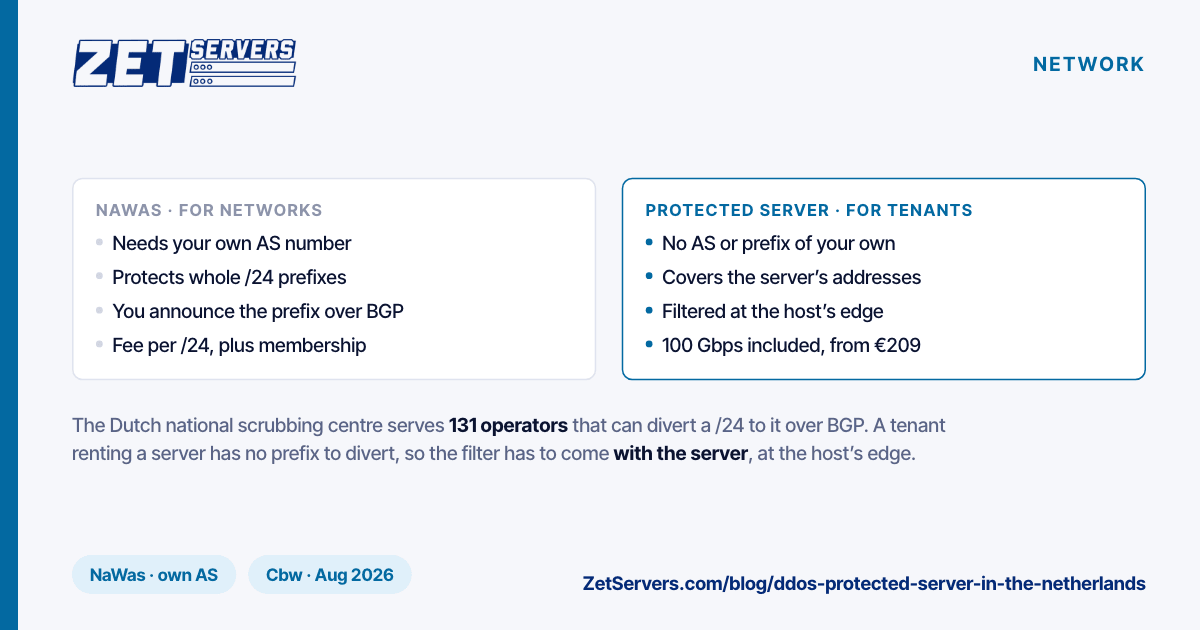
NaWas (Nationale Anti-DDoS Wasstraat) is run by NBIP, a non-profit foundation set up by the Dutch internet community. ISPs, hosting firms, financial firms and public bodies share scrubbing capacity few would buy alone; 131 organisations used it at the end of 2025. According to NBIP:
- Who can connect: operators with their own AS number and a port at a connected exchange such as AMS-IX, NL-ix or LINX, or a GRE tunnel instead.
- How it works: on-demand by default. Under attack, the participant announces the target prefix to NaWas over BGP, by hand or on a threshold; NaWas filters it and returns clean traffic over a private VLAN.
- The unit: the /24, because the internet does not accept more specific routes.
- Billing: a flat fee per protected /24, plus NBIP membership.
NaWas or a DDoS protected server in the Netherlands?
NaWas protects a network that owns its address space. A DDoS protected server in the Netherlands protects a tenant who does not.
|
NaWas |
Protection bundled with a server |
| Who can use it |
Operators with their own AS |
Anyone renting the server |
| What is covered |
Whole /24 prefixes |
The server's addresses |
| Diversion |
You announce the prefix over BGP |
The host's edge; no BGP on your side |
| Billing |
Flat fee per /24, plus membership |
A monthly tier on the server |
Most tenants have no AS and no /24 of their own, so NaWas is not theirs to join, though their host may be a participant. For a network operator it is a serious option with one job attached: triggering the redirect fast. Cloudflare's Q3 2026 report says 96% of the network-layer attacks it mitigated ended in under 10 minutes, so a redirect that waits for a human misses most of them.
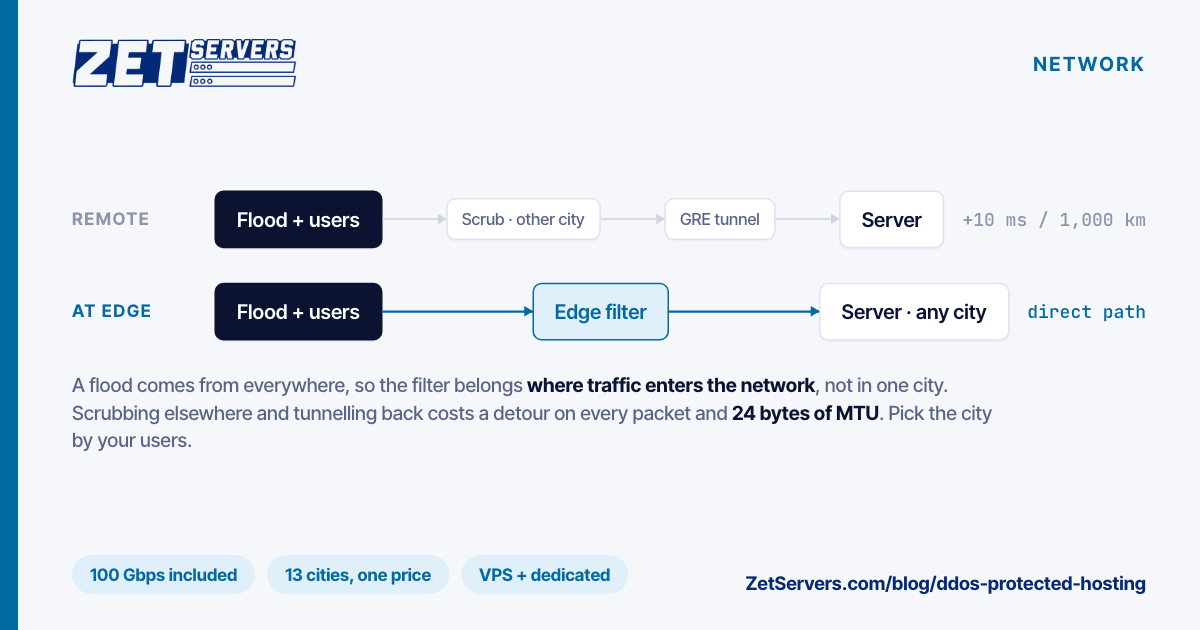
On our network the filter sits at the edge, before traffic reaches the server's port, and the tier is part of the server you order. The DDoS protected dedicated server guide explains the filtering; the DDoS protected hosting overview covers our other cities.
What the Cyberbeveiligingswet asks, and what it does not
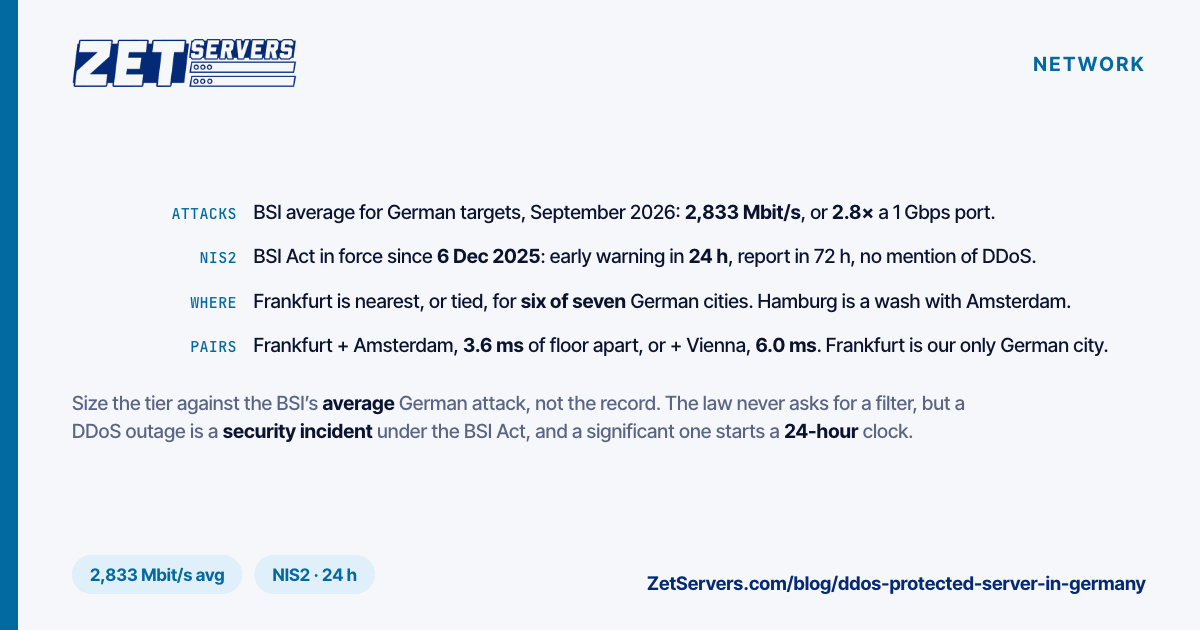
The Cyberbeveiligingswet (Cbw) took effect on 15 August 2026. It implements NIS2 for essential and important entities in 18 sectors, digital infrastructure among them; those in scope register with the NCSC. In short:
- Duty of care (article 21): appropriate and proportionate risk-management measures, including at least business continuity (backups, recovery plans, crisis management) and supply-chain security, including relationships with direct suppliers.
- Reporting (articles 25 to 29): an incident is significant if it seriously disrupts the service or causes financial loss. Your CSIRT and regulator get a warning within a day of you learning of it, a fuller notice by hour 72 and a final report a month after that.
- Board responsibility: management approves the measures.
The Act does not name DDoS protection; the term never appears in it. A flood that knocks a covered service offline can be reportable; the choice of defence is yours. If your customer is in scope, expect its supplier questionnaire to ask how you survive a flood. A standby in a second city answers the continuity item in a way a bigger tier cannot. This is a summary, not legal advice.
Sizing against Dutch numbers
NaWas publishes its largest attack each quarter. In Q4 2025 it handled 1,918 attacks, the largest 134.13 Gbps and 91.72 million packets per second; in Q2 2026, 2,767, the largest 203.44 Gbps and 102.66 million. These are peaks across all participants, not what a typical server draws, but they set a useful ceiling for sizing a DDoS protected server in the Netherlands:
| Largest NaWas attack |
Against 100 Gbps (included) |
Against 500 Gbps (€149) |
| Q4 2025: 134.13 Gbps |
34% over the tier |
27% of the tier |
| Q2 2026: 203.44 Gbps |
2.0 times the tier |
41% of the tier |
The included tier suits most Dutch shops, SaaS products and agency sites. A supplier to municipalities, a payment-adjacent service or a game community with rivals has reason to start at 500 Gbps.
The same Q4 release found application-layer DNS and HTTP request floods in 72% of attacks. Network-layer filtering passes valid HTTP requests: our tiers up to 5 Tbps cover L3 and L4, and only the 10 Tbps tier adds Layer 7. Below that, the defence is caching, rate limits and a proxy; see Layer 7 DDoS protection.
Tier prices match in every city: 100 Gbps free, then €149 (500 Gbps), €499 (1 Tbps), €999 (2 Tbps), €2,499 (5 Tbps) and €4,499 (10 Tbps with Layer 7). The entry Amsterdam 1 Gbps dedicated server (dual Xeon E5-2630 v4, 20 cores, 128 GB) runs €209 a month (€358 with 500 Gbps), and a KVM VPS €29 (€178). All prices are monthly, excluding VAT; builds in stock typically go live within an hour of payment.
What Amsterdam reaches, and where another city wins
Amsterdam is where we sell a DDoS protected server in the Netherlands, dedicated or VPS. The floor below is straight-line distance divided by 100; the estimate multiplies it by 1.3 to 1.5 and adds 1 to 2 ms. Check real paths with mtr.
| Destination |
Floor from Amsterdam |
Working estimate |
Next best of ours |
| Utrecht |
0.3 ms |
1–2 ms |
Frankfurt, 3.3 ms |
| Rotterdam |
0.6 ms |
2–3 ms |
Frankfurt, 3.6 ms |
| Groningen |
1.5 ms |
3–4 ms |
Frankfurt, 3.8 ms |
| Brussels |
1.7 ms |
3–5 ms |
Paris, 2.6 ms |
| Hamburg |
3.7 ms |
6–8 ms |
Frankfurt, 3.9 ms |
| London |
3.6 ms |
6–7 ms |
Paris, 3.4 ms (closer) |
| Manchester |
4.9 ms |
7–9 ms |
Dublin, 2.7 ms (closer) |
Dutch cities and Brussels belong to Amsterdam; Hamburg is a tie with Frankfurt. London is a tie with Paris; Manchester goes to Dublin. For a second failure domain, Frankfurt is 3.6 ms away. The Amsterdam guide covers the city's other strengths.
Frequently asked questions
Can I use NaWas to protect a rented server?
Usually not directly. NaWas connects network operators that have their own AS number and protects whole /24 prefixes they redirect to it over BGP. A typical tenant has neither. Your host may be a participant; otherwise choose one that filters at its own edge, with a tier set when ordering.
Does the Cyberbeveiligingswet require DDoS protection?
Not by name. The Act, in force since 15 August 2026, requires proportionate risk-management measures, including business continuity and supplier security, plus staged reporting of significant incidents: a warning within a day, a notice by hour 72, a final report a month later. A DDoS attack that disrupts a covered service can be reportable; the defence is your call.
How much does a DDoS protected server in the Netherlands cost?
In Amsterdam, a 1 Gbps dedicated server with 20 cores and 128 GB costs €209 a month with 100 Gbps of protection included, or €358 with the 500 Gbps tier. A KVM VPS starts at €29, or €178 with 500 Gbps. Prices exclude VAT and match every other city we sell.
Is an Amsterdam server good for users in Belgium and the UK?
For Brussels and Antwerp, yes: both are under 2 ms of round-trip floor from Amsterdam. For London, Amsterdam and Paris are effectively tied at 3.6 and 3.4 ms, both well ahead of Frankfurt at 6.4 ms. For Manchester, our Dublin location is closer, at 2.7 ms.