A DDoS protected server in Romania is a server in Bucharest, or just across the border in Sofia, whose attack traffic is filtered inside the host's network before it reaches the port. Romania gives that choice local reasons: a national cyber agency that publishes its DDoS counts, a NIS2 law with a 24-hour reporting clock, and pro-Russian hacktivist groups that have named Romanian banks, ministries and transport operators as targets.
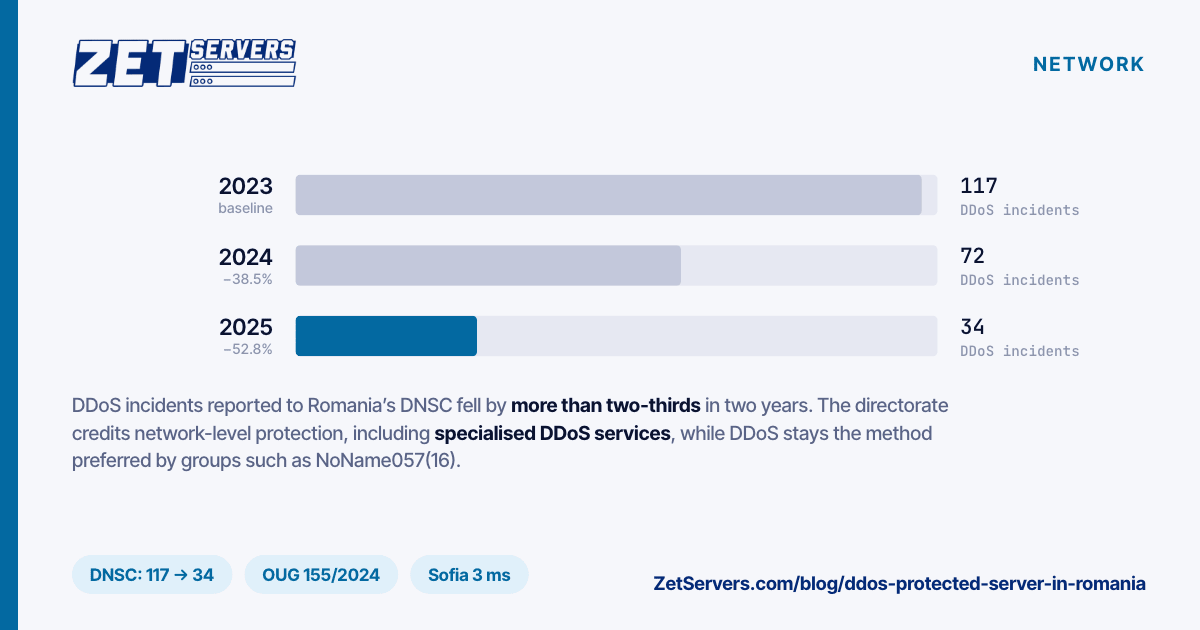
Romania's national cyber directorate, the Directoratul Național de Securitate Cibernetică (DNSC), publishes the incidents reported to it each year. DDoS has fallen two years running:
| Year |
DDoS incidents |
Change |
| 2023 |
117 |
|
| 2024 |
72 |
−38.5% |
| 2025 |
34 |
−52.8% |
The 2025 report credits better network-level protection, including DDoS protection services from specialised providers, and attackers turning to methods with greater financial impact. The 2024 report credited traffic filtering too, and added that DDoS remains the method preferred by groups such as NoName057(16), aimed mainly at the public sector and critical infrastructure. In DNSC's reading, more targets now sit behind filters, yet the attackers remain: 2025 still brought DDoS with impact on banking and transport entities.
The 2024 report's examples of Russian-origin DDoS, by sector: 17 against banking, 13 against central and local government, 12 against transport, 3 against telecoms and digital infrastructure, 2 against energy. Named targets include the National Bank of Romania, the Bucharest Stock Exchange and the Port of Constanța. These count incidents reported to one agency, not every flood on the wire.
How the campaigns against Romanian sites run
Between 17 and 21 June 2024, DNSC documented at least 25 DDoS attacks by Russia-affiliated groups on public institutions, banks, transport and telecoms companies, and its own website. It warned the targets in advance, because the attacks had been announced on the attackers' chat platforms, and reported only short, intermittent unavailability. On 4 May 2025, election day, DNSC said every site NoName057(16) had named as a target was up at 14:00.
DNSC advised a DDoS protection service that detects abnormal traffic and diverts it, plus a disaster plan. Three features of these campaigns decide what kind fits:
- Warnings reach only some targets. DNSC can call the organisations it knows about; a small shop or game server gets no call, so the filter must sit in the path permanently.
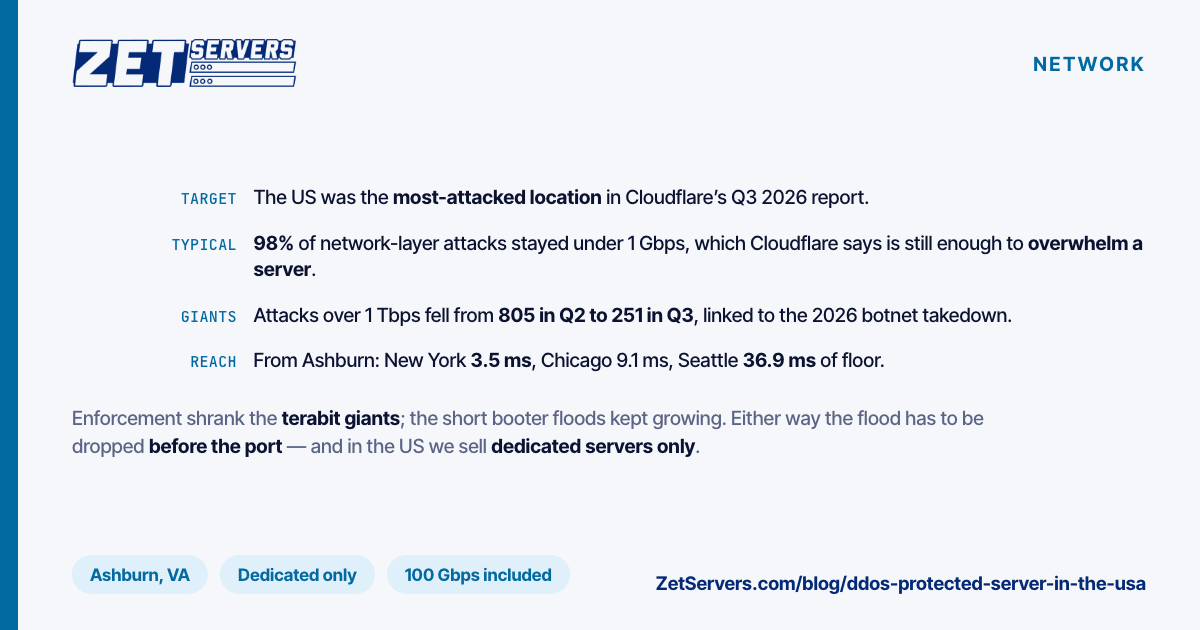
- Small floods suffice. In Cloudflare's third-quarter 2026 report, 98% of network-layer attacks stayed under 1 Gbps and 96% ended within 10 minutes. Cloudflare calls that size more than enough to overwhelm a server, and it is over before anyone reacts by hand.
- Website floods can look like visitors. Browser-like requests pass a network-layer filter; Layer 7 filtering, part of our 10 Tbps tier, handles those.
What OUG 155/2024 asks of Romanian operators
Romania transposed NIS2 through Emergency Ordinance 155/2024 of 30 December 2024, published in Monitorul Oficial no. 1332 the next day and approved with amendments by Law 124/2025. Its preamble cites attacks by groups such as Killnet on essential services in EU states that support Ukraine, Romania included. DNSC enforces it, with 644 essential and 34 important entities registered by the end of 2025.
Three provisions bear on hosting:
- Risk measures (art. 11 and 13): proportionate measures covering, at minimum, business continuity (backups, disaster recovery, crisis management) and supply-chain security, including direct suppliers such as your host.
- Reporting (art. 15): a significant incident, such as one causing or able to cause severe operational disruption or financial loss, needs an early warning to the national CSIRT within 24 hours, a notification within 72 hours and a final report within a month.
- Fines (art. 60): up to €10 million or 2% of net turnover for essential entities, €7 million or 1.4% for important ones, whichever is higher.
The ordinance never names DDoS protection, and no product makes an entity compliant. It turns an outage into a documented event with deadlines, so for an entity in scope a DDoS protected server in Romania is one input to the continuity plan, not the plan itself. This is a summary, not legal advice.
Where to put a DDoS protected server in Romania
The tier belongs to the server, not the city, so placement is a latency decision. Floors are the straight-line fibre round trip (km ÷ 100); the estimate, floor ×1.3 +1 to ×1.5 +2 ms, is for the nearest city. Check real paths with mtr.
| To |
Bucharest |
Sofia |
Vienna |
Frankfurt |
Estimate, nearest |
| Brașov |
1.4 ms |
3.7 ms |
7.6 ms |
13.5 ms |
3–4 ms |
| Constanța |
2.0 ms |
4.6 ms |
10.4 ms |
16.4 ms |
4–5 ms |
| Cluj-Napoca |
3.2 ms |
4.5 ms |
5.7 ms |
11.6 ms |
5–7 ms |
| Iași |
3.3 ms |
6.0 ms |
8.5 ms |
14.2 ms |
5–7 ms |
| Chișinău |
3.6 ms |
6.5 ms |
9.4 ms |
15.2 ms |
6–7 ms |
| Timișoara |
4.1 ms |
3.8 ms |
4.6 ms |
10.5 ms |
6–8 ms |
| Arad |
4.2 ms |
4.2 ms |
4.4 ms |
10.3 ms |
6–8 ms |
Bucharest is our nearest city for most of the country and for Moldova. The west differs: Timișoara is marginally closer to Sofia, and Arad, seat of the county where our company is registered, is a near three-way tie. For western Romania plus Hungary, Vienna is the honest answer, since Budapest has a 2.1 ms floor from Vienna and 6.4 ms from Bucharest. Frankfurt, the usual default, adds 6 to 14 ms of floor over our nearest city on every row. The Bucharest dedicated server guide covers the wider region.
A second country 3 ms away
Bucharest and Sofia are 295 km apart, a 3.0 ms floor, in two EU member states: a second failure domain with short replication paths. Sofia is also the closer of the two for Greece and the western Balkans.
Pairing a DDoS protected server in Romania with one in Sofia covers a city outage and an attack bigger than your tier, where the usual industry fallback is a null route on one address: users move to the other city. It does not outrun an attacker, who can resolve your hostname again; the filter in each city does the real work. Sofia is dedicated only, so a VPS node belongs in Bucharest.
Choosing a tier for Romanian workloads
Location and tier are separate options on one order form, so a DDoS protected server in Romania costs what it costs anywhere we sell. Every server comes with 100 Gbps of L3/L4 filtering; above that, 500 Gbps is €149 a month, 1 Tbps €499, 2 Tbps €999, 5 Tbps €2,499, and 10 Tbps with Layer 7 €4,499.
- Shops, media and SaaS for Romanian users: the included tier, on a 1 Gbps dedicated server from €209 a month or a KVM VPS from €29.
- Suppliers to banks, transport and public bodies, or anyone named on a hacktivist list: 500 Gbps to 1 Tbps, so €209 + €149 = €358 or €209 + €499 = €708 a month.
- Public portals hit by request floods: 10 Tbps with Layer 7.
- Game servers for Romanian and Moldovan players: included or 500 Gbps, tuned to the game on request; on a VPS, €29 + €149 = €178.
Sizing a tier from public attack data is covered in our guide to DDoS protected dedicated servers, and edge filtering across all 13 cities in the DDoS protected hosting overview.
Buying from a Romanian host
ZetServers is INTERKVM HOST SRL (AS 25198), registered in Lipova, Arad county, and hosting since 2010. A Romanian buyer gets a contract and invoices from a Romanian EU company and a website in Romanian. Prices are in euros, excluding VAT; in-stock builds are typically online within about an hour of payment.
Frequently asked questions
Is DDoS protection included with a server in Romania?
Yes. Every dedicated server and KVM VPS in Bucharest, and every dedicated server in Sofia, includes 100 Gbps of network-layer filtering. Larger tiers cost €149 to €2,499 a month, and the 10 Tbps tier with Layer 7 filtering €4,499. Prices are the same in all 13 of our cities.
Does OUG 155/2024 require DDoS protection?
Not by name. OUG 155/2024 requires essential and important entities to take proportionate risk-management measures, including business continuity and supply-chain security, and to report significant incidents within 24 hours, 72 hours and one month. Filtering floods is one way to support the continuity duty. This is a summary, not legal advice.
Is Bucharest or Sofia better for users in western Romania?
It is close to a tie. Timișoara has a 3.8 ms floor from Sofia, 4.1 ms from Bucharest and 4.6 ms from Vienna; Arad is 4.2, 4.2 and 4.4 ms. Choose by where the rest of your audience lives, and measure real paths with mtr first.
Does a DDoS protected server in Romania suit users in Moldova?
Yes. Chișinău has a 3.6 ms floor from Bucharest, against 6.5 ms from Sofia and 15.2 ms from Frankfurt, so Bucharest is our closest location for Moldovan users. Protection works the same for any audience, because filtering happens where traffic enters our network, not at the server.