Colocation vs dedicated servers is a capital question wearing an infrastructure costume. Renting a machine converts hardware into a monthly line item and hands the operational risk to someone else. Colocating converts it back into an asset you own, a depreciation schedule and a set of jobs that are now yours. The technical difference is small. The financial and organisational difference is the entire decision, and there is a breakeven point you can calculate rather than argue about.
What each side actually includes
A rented dedicated server is hardware, rack space, power, cooling, IP transit, IPMI access, drive replacement and a support contract, bundled into one price. When a disk dies, someone else swaps it.
Colocation is space, power and connectivity. You provide the servers, the spares, the configuration, and the person who decides what happens when a power supply fails at 4am. Remote hands exist and are billed by the incident or included by contract; either way, someone has to know what to ask for.
Everything else — network quality, uptime, physical security — comes from the facility, not from which product you bought. That is why the comparison is financial rather than technical.
The breakeven calculation
Build both sides over the same three-year window.
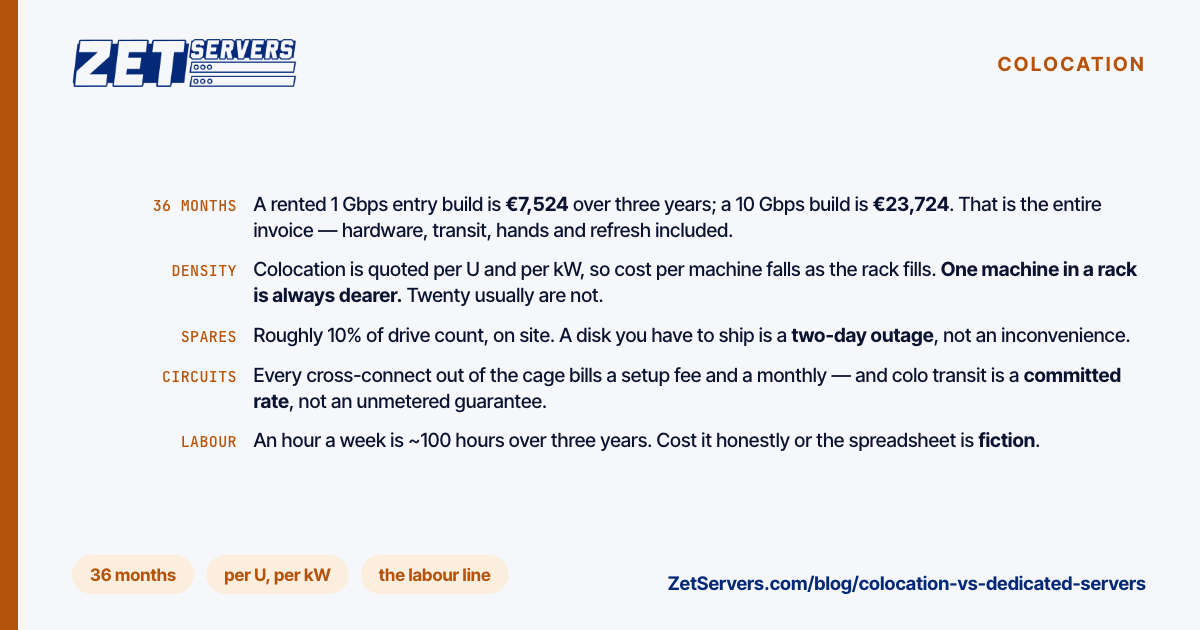
Rented, from our published entry prices: an entry 1 Gbps build at €209/month is €7,524 over 36 months. A 10 Gbps build at €659/month is €23,724.
Colocated, per machine:
hardware capex        ÷ 36
+ rack space share    (price per U or per rack ÷ machines)
+ power               (draw × facility rate)
+ transit             (committed rate or unmetered port)
+ spares              (~10% of capex, amortised)
+ remote hands        (incidents × rate)
+ your own time       (the line everyone leaves out)
Colocation is quoted per rack and per kilowatt rather than per server, so the per-machine cost falls as you fill the rack. That is the whole shape of the answer: colocation wins on density, not on the first server. One machine in a rack is always more expensive colocated. Twenty machines in the same rack usually are not.
Three inputs move the breakeven more than the rest:
Power draw, measured not assumed. A dual-socket box with 24 NVMe drives is not a 300 W machine. Facilities bill on committed kilowatts, and buying too little power means you cannot fill the rack you are paying for.
Refresh cycle. Hardware you own has a useful life; when it ends you either buy again or run equipment past its warranty. Renting moves that problem to the provider and prices it in. If you plan a 5-year life, the comparison changes materially against a 3-year one.
Your own labour. An hour a week of engineer time on hardware is roughly a hundred hours over three years. Cost it honestly and it moves the breakeven by several machines.
Where each one clearly wins
Colocation wins when:
- You already own hardware, or you have a build nobody rents — unusual drive counts, GPUs, specific NICs, custom appliances.
- You need enough machines to fill a meaningful fraction of a rack, so the fixed costs divide well.
- Compliance requires you to physically control the equipment holding the data.
- Your workload is stable enough that a three-year commitment is not a bet.
Renting wins when:
- You need fewer than roughly ten machines, or you cannot predict the number.
- Time to deploy matters — an in-stock build is online within the hour, a custom one in about a week, against weeks of procurement for owned hardware.
- You want capacity in several countries without shipping hardware to each.
- Nobody on the team wants to own a spares inventory.
The honest summary: under ten machines, rent; over a rack, colocate; between the two, the labour line decides it.
The costs that only appear on one side
Four line items exist in a colocation budget and nowhere in a rental invoice, and they are the ones spreadsheets miss:
Spares held on site. A drive that fails at 2am is only a small problem if a replacement is already in the cage. Shipping one is a two-day outage. Plan on roughly 10% of drive count and one spare power supply per chassis model.
Cross-connects. Every link out of your rack — to transit, to a peer, to another cage — is a billable circuit with a setup fee and a monthly. Two or three of them changes the per-machine arithmetic on a small footprint.
IP transit commitment. Colocation transit is usually sold as a committed rate with overage, not as an unmetered guarantee. Commit too low and you pay overage; too high and you pay for capacity you never touch.
Travel. Somebody occasionally has to be in the building. If the facility is a flight away, that is a real number, and it is the argument for buying remote hands as a contract rather than per incident.
None of these is large on its own. Together, on a footprint of five or six machines, they are frequently the difference that keeps renting ahead.
The hybrid that most people end up with
The interesting answer is usually both. Colocate the stable core — the storage nodes, the databases, the machines whose shape has not changed in two years. Rent the edges: burst capacity, new regions, anything experimental, anything you might turn off.
That split works because the two products fail differently. Owned hardware in a rack is cheap and slow to change. Rented hardware is more expensive per month and can be cancelled at the end of it. Matching each workload to the right one is worth more than optimising either in isolation.
The one thing to get right before shipping anything is the facility side. Colocation space is sold by the U, the rack or the cage, and the details that cause problems on install day — chassis depth against cabinet depth, continuous load against breaker rating, whether A and B feeds each carry the whole rack alone, IPMI addressed and tested before the pallet leaves — are all cheaper to fix beforehand. The colocation checklist is the pre-flight for exactly that.
Questions to answer before you decide
- How many machines in 12 months, and how confident is that number?
- What is the measured power draw per machine, not the label rating?
- Who physically responds at 4am, and what does that cost per incident?
- What is the refresh plan at 36 months?
- Does any of this hardware need to be somewhere your team cannot drive to?
If the answers point at a rack, get a colocation quote and price it against the rented equivalent using the formula above. If they point at four machines, rent them and revisit in a year — the arithmetic will still be there.
Frequently asked questions
Is colocation vs dedicated servers really about cost?
Cost is the largest term, but control is the tiebreaker. Colocation is the only option if you need specific hardware or physical custody of the equipment, whatever the spreadsheet says.
How many servers before colocation makes sense?
Around ten as a rough marker, and a rack as a confident one. Below that, the fixed costs — space minimum, power commitment, spares, hands — divide across too few machines.
Can I colocate hardware I bought elsewhere?
Yes. That is the normal case. Check depth, weight, power draw and rail compatibility against the cabinet before shipping.
What about network quality — is one better than the other?
No. Both sit on the same backbone in the same facilities. Transit terms differ: rented servers include an unmetered guaranteed rate, colocation is quoted as a port with either unmetered or committed-rate transit.
Can I mix the two?
Yes, and most growing infrastructure does. Colocate the stable core, rent the edges and the experiments.