A Vienna dedicated server is the one to pick when your users live east and south of the German-speaking world rather than inside it. Vienna sits a short drive from the Slovak and Hungarian borders and not much further from Czechia, Slovenia and Croatia, so one machine here reaches six EU countries inside a working estimate of about 6 ms. Austria itself is only about 6 ms from Frankfurt anyway, which is why the case for Vienna is not Austria: it is the region around it. This guide covers who it serves, the numbers behind that and where another of our cities does better.
Why Vienna, and who it is for
Vienna sits near the middle of the Danube region. Bratislava is 55 km away, close enough that the two capitals behave like one metro. Brno, Graz, Budapest, Prague, Ljubljana and Zagreb all fall within 300 km.
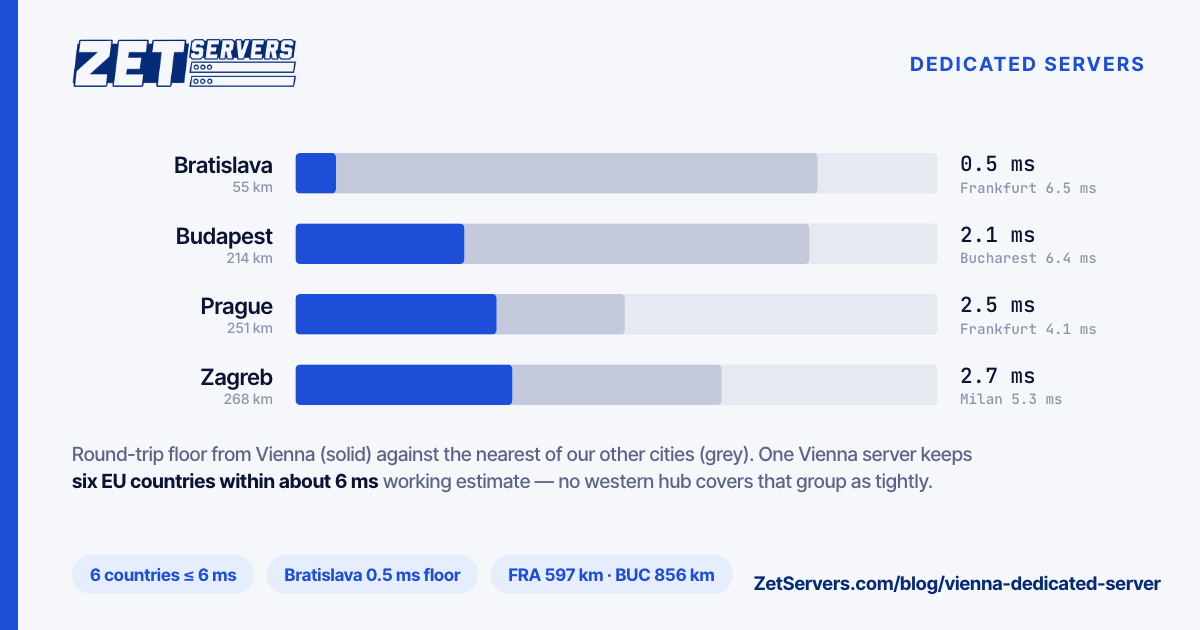
That geometry is the whole argument. A Czech SaaS product, a Hungarian news site, a Slovak shop and a Slovenian game community are four different audiences, but from Vienna every one of them is less than 3 ms of floor away. Serve the same set of users from Frankfurt and the floor to Budapest rises from 2.1 ms to 8.1 ms, to Bratislava from 0.5 ms to 6.5 ms, and to Zagreb from 2.7 ms to 7.2 ms. Austria is in the EU, so a Vienna dedicated server keeps personal data inside the Union.
The latency floor from Vienna
Light in fibre covers about 200 km per millisecond, so the round-trip floor is the straight-line distance divided by 100. Real paths are longer, so the working estimate multiplies the floor by 1.3 to 1.5 and adds one or two milliseconds of router delay:
| From Vienna to |
Great-circle |
Theoretical floor |
Working estimate |
| Bratislava |
55 km |
0.5 ms |
2–3 ms |
| Brno |
111 km |
1.1 ms |
2–4 ms |
| Graz |
145 km |
1.4 ms |
3–4 ms |
| Budapest |
214 km |
2.1 ms |
4–5 ms |
| Prague |
251 km |
2.5 ms |
4–6 ms |
| Zagreb |
268 km |
2.7 ms |
4–6 ms |
| Ljubljana |
278 km |
2.8 ms |
5–6 ms |
| Munich |
355 km |
3.6 ms |
6–7 ms |
| Belgrade |
492 km |
4.9 ms |
7–9 ms |
| Warsaw |
556 km |
5.6 ms |
8–10 ms |
| Frankfurt |
597 km |
6.0 ms |
9–11 ms |
| Bucharest |
856 km |
8.6 ms |
12–15 ms |
Two rows deserve a caveat. Munich is closer from Frankfurt (3.0 ms) than from Vienna (3.6 ms), so Bavaria is no reason to choose Vienna. Belgrade is a near tie: 4.9 ms from Vienna against 4.5 ms from Bucharest, so a Serbian audience should be decided by where the rest of your users are.
These are planning figures, not measurements. Before committing, run a trace from where your users actually are and compare the real path with the floor.
Workloads that fit Vienna
One server for several small national markets. Central European products often sell into three or four countries at once. Vienna lets a single origin serve Prague, Bratislava, Budapest and Ljubljana with no user more than a few milliseconds of floor away, instead of splitting the difference from a hub in the west.
Game servers for central European communities. Competitive games feel every millisecond, and a community that mixes Czech, Slovak, Hungarian and Croatian players has no single home country. Vienna is the point that keeps the furthest of them closest. For players spread from Warsaw to Belgrade, it still holds everyone within a 10 ms working estimate.
Regional media and streaming. A news portal, a radio stream or a video service aimed at the Danube countries gets its shortest paths from here.
A test box before the order. Unmetered KVM VPS from €29 a month is also sold in Vienna. It is a cheap way to measure real paths before committing to a dedicated build.
When Vienna is the wrong choice
Your users are in Germany, Switzerland or the Benelux. Frankfurt is closer to all of them, and German-speaking Austria is within about 6 ms of Frankfurt in any case.
Your users are further south-east. Bucharest is closer to Belgrade, and much closer to Sofia, Istanbul and Athens. A Balkan audience centred below the Danube belongs in Bucharest, not Vienna.
Your users are in Poland. Warsaw is 5.6 ms of floor from Vienna, which is fine for a minority of Polish users but not for a Polish-first service. Put that in Warsaw.
Your audience is the whole continent. For a single origin serving everyone from Lisbon to Helsinki, the central western hub minimises the worst case. Vienna is a regional answer, not a continental one.
Pairing Vienna with a second city
A service that must survive a regional outage needs a second city. Vienna has two natural partners.
Vienna and Frankfurt, 597 km apart, 6.0 ms of floor. Close enough that replication lag stays small, and the pair covers the German-speaking market and central Europe between them.
Vienna and Bucharest, 856 km apart, 8.6 ms of floor. Further apart and further from western Europe, which makes the pair a strong fit for a service whose users run from Prague to the Black Sea. Bucharest takes Romania and the southern Balkans; Vienna takes the countries to its north and west.
Whichever you pick, keep backups in a third place: a copy in the same city as the primary does not survive the incident you are planning for.
What a Vienna dedicated server costs
Vienna is a €0 option in the location selector at checkout, so it costs the same as every other location we sell. Entry prices for the tiers that fit the workloads above:
Larger builds go up to dual EPYC with 512 threads. Stock differs by city: a build that is on the shelf in Frankfurt may be built to order in Vienna, or the other way round, and most in-stock builds are online within an hour of payment. The unmetered dedicated server buyer's guide compares every tier by cost per delivered terabyte.
A practical Vienna checklist
- List your top countries by users, then check each against the table. If most sit between Prague, Budapest and Zagreb, Vienna is the right call.
- Check the honest exceptions: Germany and Switzerland favour Frankfurt, Serbia is a tie with Bucharest, Poland belongs in Warsaw.
- Size the port for peak egress, not the monthly average.
- Choose the second city — Frankfurt for a close pair, Bucharest for a wider one.
- Put backups somewhere else again.
Frequently asked questions
Who is a Vienna dedicated server best for?
Services whose users are spread across Austria, Czechia, Slovakia, Hungary, Slovenia and Croatia. From Vienna all six are within a working estimate of about 6 ms, which no western hub can match for that group of countries.
Is Vienna better than Frankfurt for Austrian users?
Only slightly. Austria is about 6 ms of floor from Frankfurt, so a German-speaking audience in Austria is served well from either. Vienna pulls ahead when your users are also in Budapest, Bratislava, Prague or Zagreb.
Does a Vienna server cost more than other locations?
No. The 1 Gbps entry build is €209 a month in Vienna, the same as everywhere else, because the city is a free option at checkout. Only stock can differ between cities.
What latency should I expect from Vienna to Budapest?
The straight-line floor is 2.1 ms round trip, and real paths usually land between 4 and 5 ms. Measure from your users' networks before deciding; these figures are estimates, not guarantees.