Ask a transit provider what a gigabit costs and the answer arrives wrapped in a rule most buyers have never had explained to them: 95th percentile billing. It is not a discount, it is not a cap, and it is not the average of your traffic. It is a specific piece of arithmetic performed on your interface counters at the end of every month, and once you can do that arithmetic yourself you can predict the invoice before it arrives — and tell instantly whether a flat unmetered price is cheaper for the shape of traffic you actually push.
The arithmetic, exactly
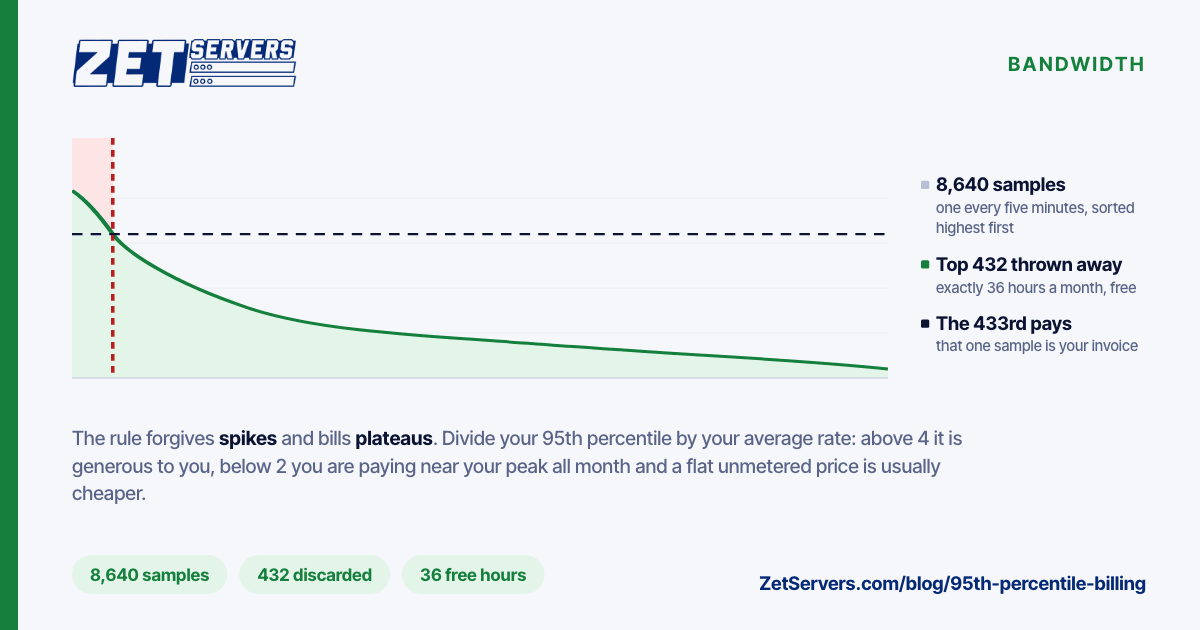
Your provider polls the switch port your server plugs into, normally every five minutes, and records the average bit rate over each interval. At the end of the month:
- Every sample is sorted, inbound and outbound kept as separate series.
- The top 5% of samples are discarded.
- The highest remaining sample is the billed rate — usually the larger of the two directions.
Run the numbers on a 30-day month. There are 12 five-minute intervals per hour, 288 per day, so 30 × 288 = 8,640 samples. Five percent of 8,640 is 432 samples, and 432 × 5 minutes is 2,160 minutes — exactly 36 hours. On a 31-day month it is 8,928 samples, 446 discarded, a little over 37 hours.
That is the whole mechanism. You get 36 hours a month, in five-minute pieces, during which your traffic is invisible to billing. The 8,209th-highest sample of a 30-day month pays for everything.
What the rule rewards, and what it punishes
It rewards short spikes. A launch, a patch day, a viral hour, a nightly backup window — anything that fits inside 36 monthly hours costs nothing. Providers know this and price accordingly; it is a genuine allowance, not a trap.
It punishes plateaus. Traffic that sits at a level for two hours a day, every day, spends 60 hours a month up there. Only 36 are free. The remaining 24 set your bill, and they set it at the full plateau height.
The number that decides which side you land on is your peak-to-average ratio. Take your monthly transfer, convert it to an average rate, and divide the 95th percentile by it:
- Ratio above 4 — spiky. Percentile billing is generous to you.
- Ratio 2 to 4 — typical web and API traffic. Roughly neutral.
- Ratio below 2 — a plateau: streaming, backup targets, CDN origins, VPN exits. You are paying near your peak, all month, and a flat unmetered price is usually cheaper.
Converting a percentile to a flat price
The comparison people get wrong is billed rate against port speed. Do it as cost per delivered terabyte instead, because that is what your business actually consumes.
A fully saturated 1 Gbps link moves 125 MB per second. Over a 30-day month — 2,592,000 seconds — that is 324 TB. Scale it linearly: 10 Gbps saturated is 3,240 TB, and 100 Gbps is 32,400 TB.
Now price both sides:
| Guaranteed rate |
Monthly price |
Saturated transfer |
Cost per TB |
| 1 Gbps |
€209 |
324 TB |
€0.65 |
| 10 Gbps |
€659 |
3,240 TB |
€0.20 |
| 100 Gbps |
€4,499 |
32,400 TB |
€0.14 |
Those are whole-server prices from our 1 Gbps, 10 Gbps and 100 Gbps ranges — CPU, RAM, disks and transit together, with no separate bandwidth line. Against a metered quote, substitute your own per-GB rate and multiply by the terabytes you deliver. Most people discover the crossover is far lower than they assumed, because they had been comparing a percentile rate against a port speed and the two are not the same unit.
The catch, stated plainly: those per-terabyte figures assume you saturate the link. At 20% utilisation the 10 Gbps box costs €1.02 per delivered terabyte, not €0.20. Flat pricing rewards high, steady utilisation — precisely the traffic shape that percentile billing punishes. That symmetry is the entire decision.
Measuring your own percentile before you sign anything
You do not need the provider's data. Poll your own interface counters every five minutes, keep 30 days, sort, drop the top 5%:
cat /sys/class/net/eth0/statistics/tx_bytes    ## one sample, bytes since boot
echo $(( (tx2 - tx1) * 8 / 300 ))              ## rate between samples, bit/s
Any polling stack already does this — an SNMP collector, Prometheus with node_network_transmit_bytes_total, or a five-line cron job writing to a text file. Thirty days later, sort the file numerically, count the lines, discard the top 5%, and read off the next value. That is your billed rate under any provider using this rule, to within polling error.
Two details that shift the answer more than people expect. Sample both directions and bill on the larger: a backup target or a video ingest point often bills on inbound, which nobody watches. And be honest about which server you are measuring — percentile billing is usually applied per port, so ten servers each peaking at different hours bill much better than ten servers peaking together.
Frequently asked questions
Is 95th percentile billing the same as unmetered?
No, and they are close to opposites. Percentile billing charges for the rate you sustain and forgives short bursts. Unmetered charges a flat price for a guaranteed rate with no traffic component at all — what unmetered bandwidth actually means covers where the guarantee sits.
Why 95 and not 99, or the average?
Convention, inherited from carrier transit contracts, and a reasonable compromise: it forgives genuine bursts without letting a customer sustain double their committed rate for a day and pay nothing. The average would let anyone run flat out for 36 hours and pay for a fraction of it.
Does inbound traffic count?
Usually yes, as a separate series, with the higher of the two directions billed. Read your contract — some providers bill only egress, and the difference is large for backup and ingest workloads.
Can I game the 36 free hours?
Deliberately, no — spreading a bulk transfer across the month raises your plateau and makes the bill worse. Scheduling a large one-off migration inside a single window is not gaming anything, it is exactly what the allowance exists for.
How do I know which model suits my traffic?
Compute the peak-to-average ratio from a month of samples. Below 2, flat unmetered wins on almost any realistic quote; above 4, percentile billing is probably cheaper. How much bandwidth do you need works through sizing the rate itself.