A DDoS protected server in Germany is, for most buyers, a Frankfurt machine whose provider drops attack traffic inside its own network, so the server keeps answering through a flood. Germany is worth its own post: its federal cyber agency publishes attack figures you can size a tier against, its NIS2 law has applied since 6 December 2025, and Frankfurt is not the nearest of our cities for every German user.
What the BSI measures in Germany
The Federal Office for Information Security (BSI) counts DDoS attacks on targets inside AS3320, Deutsche Telekom's network, as an index where 2021 equals 100. Its 2025 annual report, covering July 2024 to June 2025, found attacks almost 40% more frequent per month than in the 2021 reference year. Between the federal election and the Munich Security Conference in February 2025, attacks ran 52% above the long-term average.
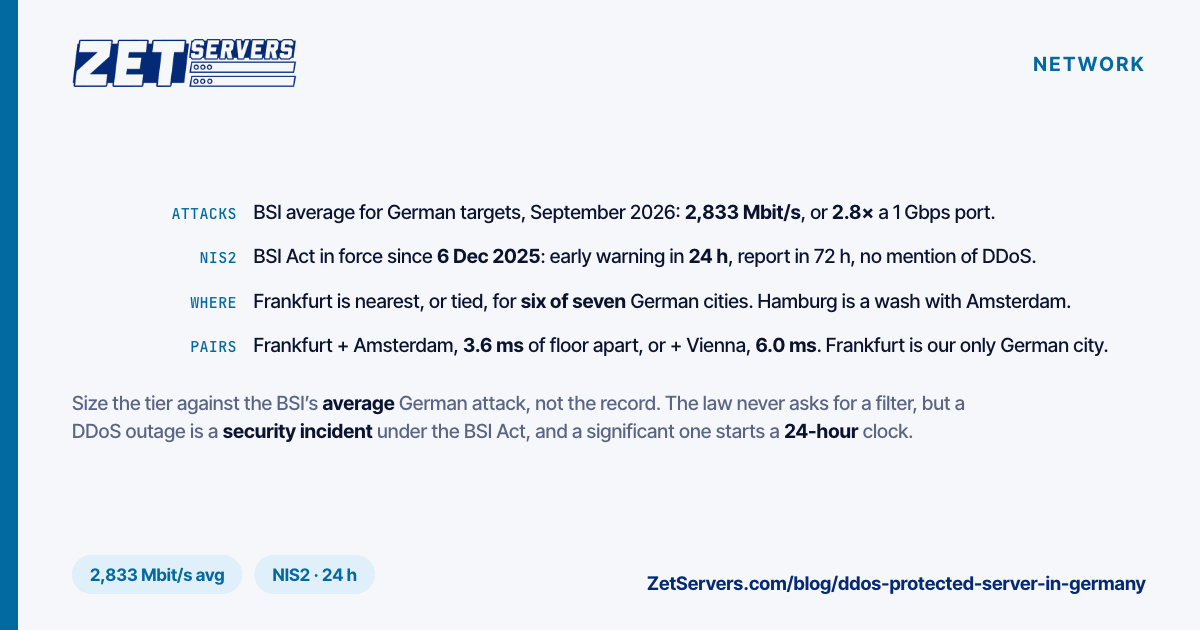
For September 2026 the BSI reports an index of 135 and an average of about 2,833 Mbit/s per known attack. That is a mean, not a record, and 2.8 times what a 1 Gbps port carries. A 1 Gbps server with no upstream filter can be knocked offline by an average-sized attack, not just a record one. The BSI itself calls average bandwidth a guide for dimensioning network connections and protective measures.
Hacktivists, botnets and Germany's ranking
The pro-Russian group NoName057(16) floods websites with HTTP requests from DDoSia, a tool whose instances work together like a botnet. Monitoring targets named on its lists from June 2024 to June 2025, the BSI found that 19% of attacks made the server unavailable and 29% had no effect at all. Municipalities and small firms can land on those lists too, its September 2026 report notes.
The heavy end is IoT botnets. On 19 March 2026 the BKA and North Rhine-Westphalia's cybercrime prosecutors (ZAC NRW) acted with Canadian and US authorities against Aisuru and Kimwolf, botnets of several million hijacked routers, webcams and TV boxes, while the BSI sinkholed their infrastructure. Cloudflare's Q3 2026 report counts 251 network-layer attacks above 1 Tbps, down from 805 in Q2, a fall it says coincides with the action against four IoT botnets, these two among them.
Cloudflare ranked Germany the most attacked country in its 2025 Q1 data, third in Q2 and Q3, and in the top five in Q4. Neither 2026 report so far has it in the top three.
NIS2 in Germany: what the BSI Act requires
Germany implemented NIS2 by rewriting its BSI Act (BSIG), dated 2 December 2025 and in force since 6 December 2025. The BSI expects about 29,500 organisations to fall under it, up from about 4,500, and 20,141 had registered by 30 September 2026.
In a listed sector, such as digital infrastructure (managed service providers included), online marketplaces, health or energy, a company is an important entity from 50 employees, or above €10 million in both turnover and balance sheet. In Annex 1 sectors it is particularly important from 250 employees, or above €50 million turnover and €43 million balance sheet. An agency that size which runs client servers should check whether it counts as a managed service provider.
Covered organisations must register with the BSI within three months of falling in scope, take documented risk-management measures and report significant incidents under § 32: an early warning within 24 hours of becoming aware, a fuller report within 72 hours, and a final report a month later.
The act never mentions DDoS protection. It defines a security incident as anything impairing the availability, integrity or confidentiality of services, so an attack that takes a service offline is one; it is reportable when it causes or can cause serious disruption or financial loss. The minimum measures in § 30 include incident handling, business continuity and supply-chain security, which covers your hosting provider. If you buy a DDoS protected server in Germany for a regulated service, record the tier, where filtering happens and how you will learn of an attack. This is not legal advice.
The BSI also lists 24 qualified DDoS mitigation providers (as of 15 May 2026). We are not among them, so our bundled filtering will not satisfy a tender that demands a listed provider.
Choosing a DDoS protected server in Germany: Frankfurt and the exceptions
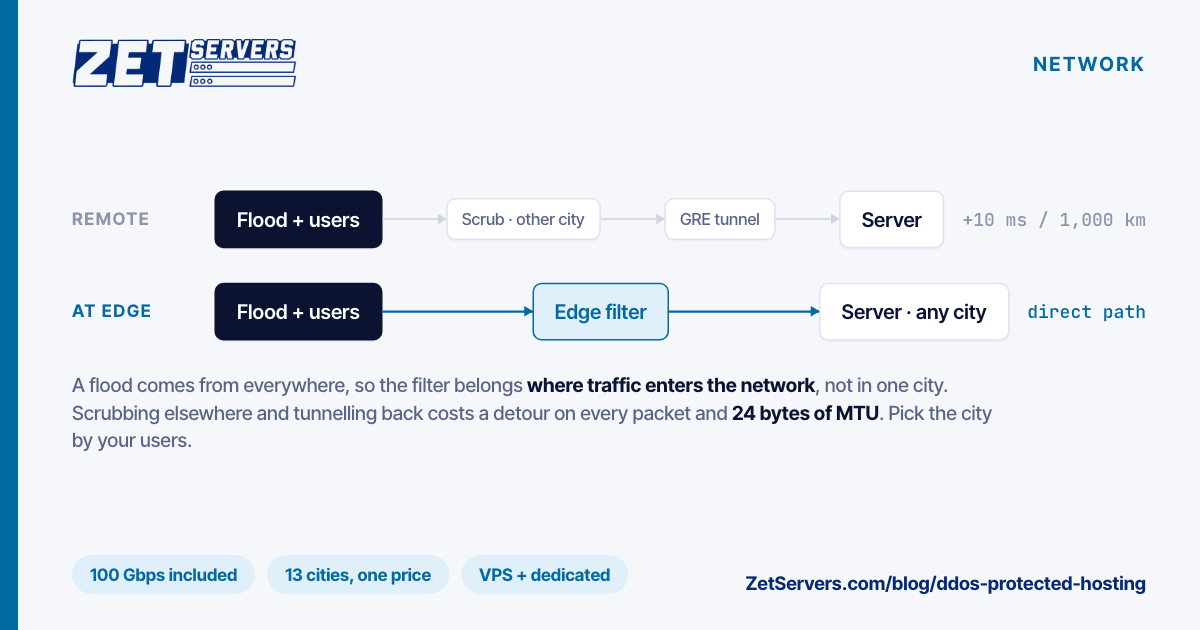
Frankfurt is our German city, for dedicated servers and KVM VPS. Filtering runs at our network edge, so the city changes the round trip to your users, not the protection. Each floor is the great-circle distance in kilometres over 100, the shortest round trip fibre allows; scale it by 1.3 to 1.5 and add 1–2 ms for a working estimate. Confirm real paths with mtr before ordering.
| German city |
Floor from Frankfurt |
Next closest of ours |
Estimate from Frankfurt |
| Cologne |
1.5 ms |
Amsterdam, 2.1 ms |
3–4 ms |
| Stuttgart |
1.5 ms |
Milan, 3.7 ms |
3–4 ms |
| Leipzig |
2.9 ms |
Vienna, 4.5 ms |
5–6 ms |
| Munich |
3.0 ms |
Milan, 3.5 ms |
5–7 ms |
| Dresden |
3.7 ms |
Vienna, 3.7 ms |
6–8 ms |
| Hamburg |
3.9 ms |
Amsterdam, 3.7 ms |
6–8 ms |
| Berlin |
4.2 ms |
Warsaw or Vienna, 5.2 ms |
6–8 ms |
Frankfurt is nearest, or tied, for six of the seven. Hamburg is a wash: 3.7 ms from Amsterdam against 3.9 ms from Frankfurt, less than the spread between two real routes. Dresden ties with Vienna. Across the border, Vienna, 6.0 ms from Frankfurt, pulls ahead when the same service has users in Budapest (2.1 ms against 8.1 ms), and Milan edges out Frankfurt for Zurich (2.2 ms against 3.0 ms).
What German buyers run, and how to size it
Game communities draw rivals, banned players and booter customers. Game traffic is mostly UDP, where a generic rate limit drops real players with the attack, so on our game server hosting the policy is tuned to your titles on request. Start on the included tier unless your history says otherwise; the DDoS protected dedicated server guide maps attack profiles to tiers.
Online shops lose orders while down, and the BSI lists financial loss for shops among DDoS consequences. An HTTP flood of valid-looking requests needs Layer 7 filtering, which comes with our 10 Tbps tier, so a smaller shop should also rate-limit and cache in the application.
Agencies put many client sites on one server. If one client draws an attack and the host null-routes the address, every site on it goes dark: the best argument for filtering over blackholing.
A DDoS protected server in Germany costs the same with us as in our other 12 cities. Tiers per month, excluding VAT: 100 Gbps included, 500 Gbps €149, 1 Tbps €499, 2 Tbps €999, 5 Tbps €2,499, and 10 Tbps with Layer 7 at €4,499. A 1 Gbps dedicated server with dual Xeon E5-2630 v4 and 128 GB is €209, or €358 with 500 Gbps; a KVM VPS is €29, or €178 with the same tier.
Pairing Frankfurt with a second city
A filter does nothing for a facility outage, and if a contract demands both copies inside Germany, we cannot meet it: Frankfurt is our only German city. Otherwise, two pairs suit a German audience.
Frankfurt and Amsterdam are 363 km and 3.6 ms of floor apart, about 6–7 ms by the estimate. Amsterdam matches Frankfurt for Hamburg, and both sell VPS too.
Frankfurt and Vienna are 597 km and 6.0 ms apart, a fit for a DACH service with users towards Hungary.
Size each server's tier separately; our DDoS protected hosting overview lists pairs in other regions.
Frequently asked questions
Where is a DDoS protected server in Germany located with ZetServers?
In Frankfurt, our only German city, where we sell dedicated servers and KVM VPS. Every server includes 100 Gbps of network-layer filtering at our network edge, before traffic reaches its port. Larger tiers, up to 10 Tbps with Layer 7, cost the same in Frankfurt as in our other 12 locations.
Does NIS2 require DDoS protection in Germany?
Not by name. The BSI Act, in force since 6 December 2025, requires covered organisations to take risk-management measures, including incident handling and business continuity, and to report significant incidents, starting with an early warning within 24 hours. An outage caused by a DDoS attack can be one. This is not legal advice.
How large are DDoS attacks against German targets?
The BSI measures attacks inside Deutsche Telekom's network. For September 2026 it reports an average of about 2,833 Mbit/s per known attack, 2.8 times the capacity of a 1 Gbps port. Even the average fills a small uplink, so filtering has to happen upstream.
Is Frankfurt the best city for users in Hamburg or Munich?
For Munich, yes: 3.0 ms of floor from Frankfurt, against 3.5 ms from Milan and 3.6 ms from Vienna. Hamburg is a near tie, 3.7 ms from Amsterdam and 3.9 ms from Frankfurt, so let the rest of your audience decide, and check real paths with mtr.